ALTOONA LOSES TOWN CHARTER
Even though the mayor and council appeared to have strong momentum, trouble was brewing behind the scenes. Two months after taking office, Councilman McIlquham made a motion that Hugh Whitt, a Gadsden attorney be employed as the town attorney for $50 a year.[1] The action was seconded by Cagle and the remainder of the council passing the motion unanimously. In January, Whitt appeared before the council to explain the suit against the Gulf State Steel Company, as well as the error in the town charter.[2] Unfortunately, there is no record of the Gulf State Steel lawsuit, and it may have been abandoned by the town considering the ongoing issue with the town charter.
When Altoona was chartered, the corporate limits which were to define the town were to be surveyed, platted, and physically described. This survey, plat, and description were completed on October 31, 1907, and added to the incorporation petition that was later adopted when Altoona was officially incorporated in 1908.[3] For almost 10 years Altoona operated under this charter without any issues. However, at some point, it was discovered that the original survey description was incorrect. The original description states that the survey began in the Northwest (NW¼) corner of the Southwest (SW¼) corner, of Township 11, Range 3 East, Section 32. This was supposed to signify a starting point on the Blount/Etowah County line, as Altoona was to only be incorporated in Etowah County. However, the (NW¼) corner of the Southwest (SW¼) corner, of Township 11, Range 3 East, Section 32 is one mile west of the county line, well into Blount County. This error made the survey illegal, which invalidated the original town charter, and made Altoona nothing more than a name.
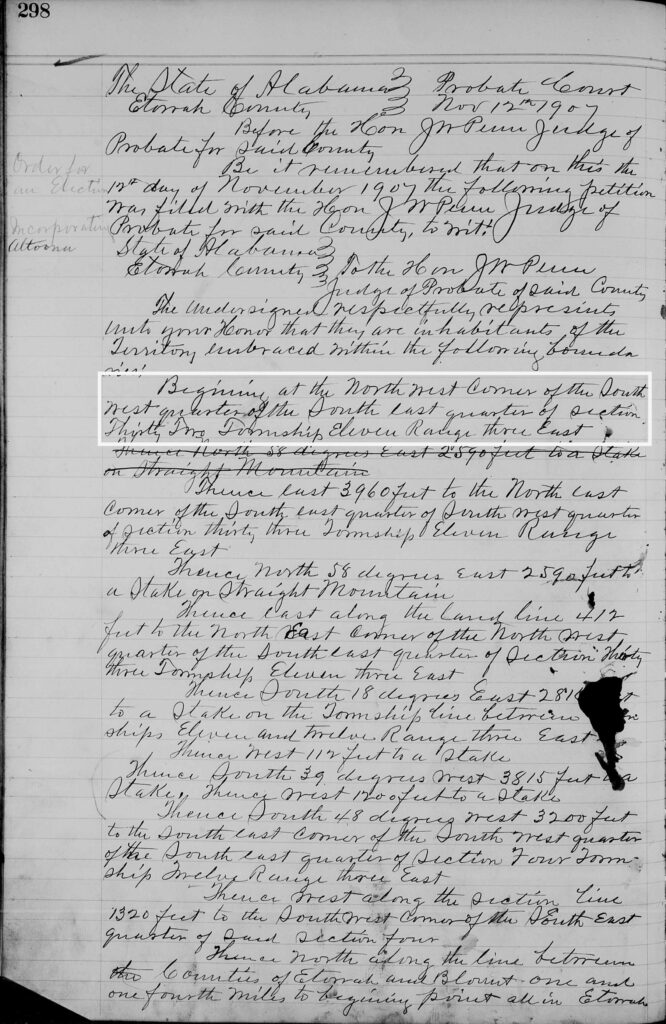
After almost a decade, why did the error become an issue in the first place? It stemmed from the fact that the town wanted to issue bonds to build a new school.[4] During the process, the original incorporation papers were inspected, and the error was found. The case was then carried to the Etowah County Circuit Court as a quo warranto proceeding.
The plaintiff in the case was T.B. Wagnon, who was represented by Culli & Martin. It is unknown why Wagnon, who was a merchant in town was the plaintiff. However, since the entire issue was uncovered because of a potential school bond, Wagnon may have been one of the school trustees. While those appointments were supposed to be confirmed by the council and Wagnon is not mentioned in the minutes, it’s probable that his appointment (like many others through the years) fell through the crack and was never confirmed.
The case appeared before judge J.A. Steele of the Etowah County Circuit Court in early June 1917. The proceedings were expedient, with the verdict being reached on June 8.[5] The decision of the court was to hear the case without the intervention of the jury. The judgment was in favor of the town, with the simple verdict of the “petition being denied.” A later report said that prior to the circuit court judgment, the case was to be elevated to the Alabama Supreme Court, regardless of the outcome.[6] Due to this, court officials simply denied the petition instead of rendering a decision, when it would simply be appealed. Additionally, the court wanted to save Altoona from any embarrassment by dissolving the town charter prior to any appeal.
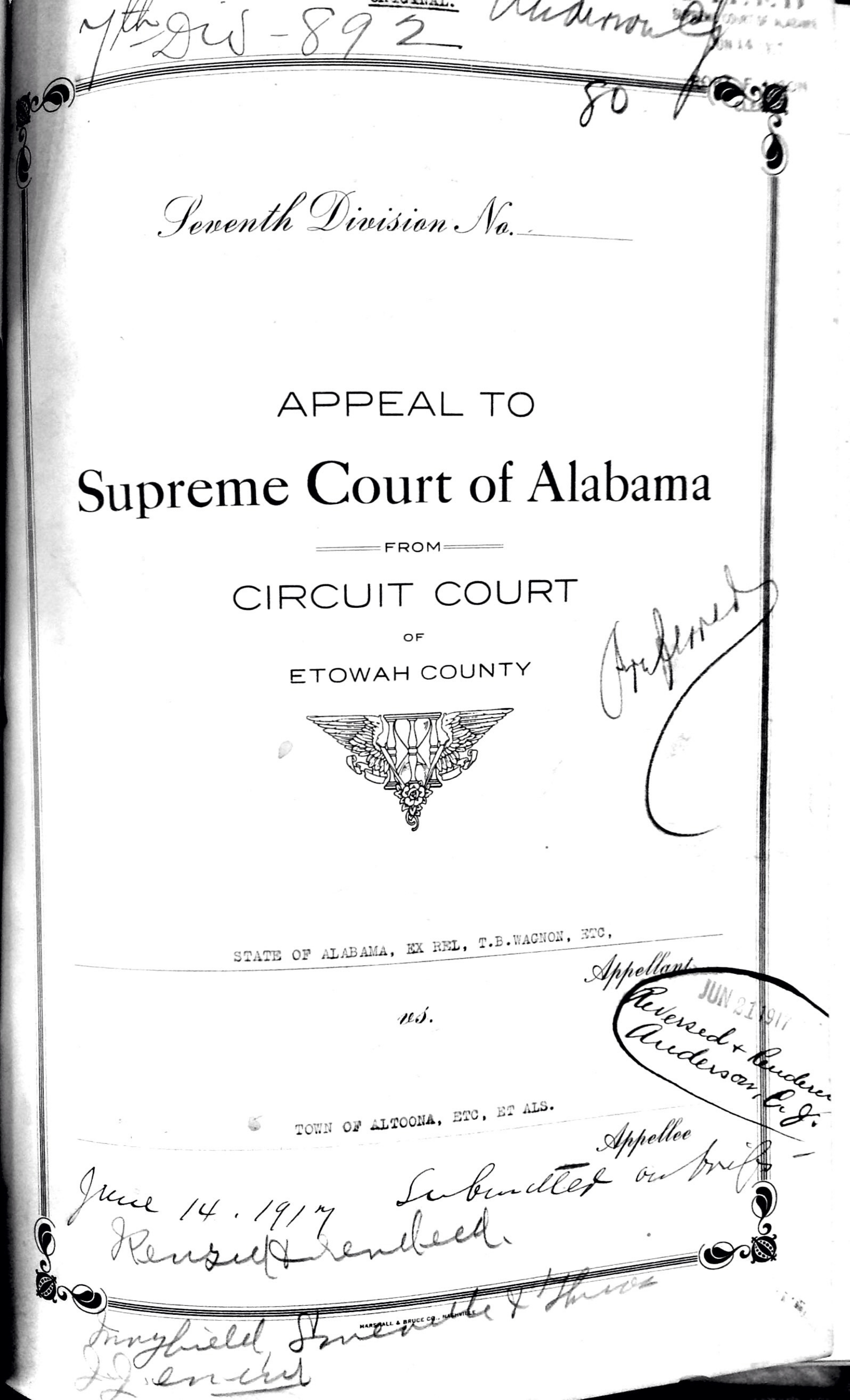
Immediately after the circuit court judgment was rendered, appeal papers were filed with the Supreme Court of Alabama, with the process being complete on June 11. These papers give some insight into Altoona’s position in the matter. The town argued that the mistake in the description and plat was a simple clerical error and could be corrected by amendment in the probate court. Fortunately, the Alabama Supreme Court took up the case quickly, with the verdict being issued on June 21.[7] Unfortunately for the town, the verdict was not in their favor.
The court ruled that, “Where the plat of territory to be embraced in a proposed town set up an impossibility, the plat was void on its face, regardless of the county or counties in which it placed the land.” To reach this verdict, the court cited the case of State ex rel. Va. Town of Phill Campbell, 177 Ala. 204 which stated: “Under section 1053 of the Code of 1908, it was the essential right of the probate judge to act that the petition have attached thereto an accurate plat locating and describing the territory to be embraced in the proposed town. It was also held that, if the plat was so indefinite and uncertain as to the territory to be incorporated, it would be fatal to the incorporating proceedings, and that the deficiency could not be cured by an ascertainment by the judge that the plat was accurate, as attaching of a plat to the petition was jurisdictional, and an indefinite and void plat was the equivalent of no plat.” More importantly, the verdict “rendered quashing the incorporation proceeding and ousting the respondents.” In short, Altoona lost its charter and was no longer a town. In fact, it was never a town. All elections, ordinances, licenses, etc., were nullified by the ruling.
The results of the decision were well publicized. The Gadsden Times reported that the “town of 2,000 inhabitants is without a separate municipal government and the mayor, aldermen and policemen are out of a job.”[8] However, it reiterated that the proceedings were of “a friendly nature.” The Gadsden Evening-Journal devoted a longer article that provided additional details about the case from its origin to the circuit court.[9] Both articles were picked up by wire reporters and appeared throughout the state.

However, it appears that Altoona was prepared for, and fully expected the decision. The Gadsden Times reported that “steps will be taken immediately to incorporate the town in a legal way and petitions to that end are being prepared.” The last paragraph reads, “It was though best to dissolve the corporation and start anew as the town could never issue bonds or incur outside obligations, nor could it legally enforce its decrees under the old order.” At the surface, this statement appears to have come from an official with the town and not the court. Although the town argued that the issue could be fixed through a simple amendment, deep down the town attorney may have informed them it would have been an uphill battle, and the mayor and council knew all along that the charter would be invalidated. Unfortunately, there is nothing definite to confirm this, just bits and pieces that lead to more speculation.
ALTOONA OFFICIALLY REINCORPORATED
While the case went from the Etowah County Circuit Court to the Alabama Supreme Court in less than 22-days, the reincorporation of the town was not that efficient. During the time when the town lost its charter, police protection was provided to the town by the Etowah County Sheriffs Department and all governmental activity and administration in the community ground to a halt. Five days after the ruling, a new incorporation petition was submitted to Etowah County probate judge L.L. Herzberg. This petition contained the correct property description for the incorporation as well as being signed by 35 prominent Altoonaites who wished for the town to be incorporated again:
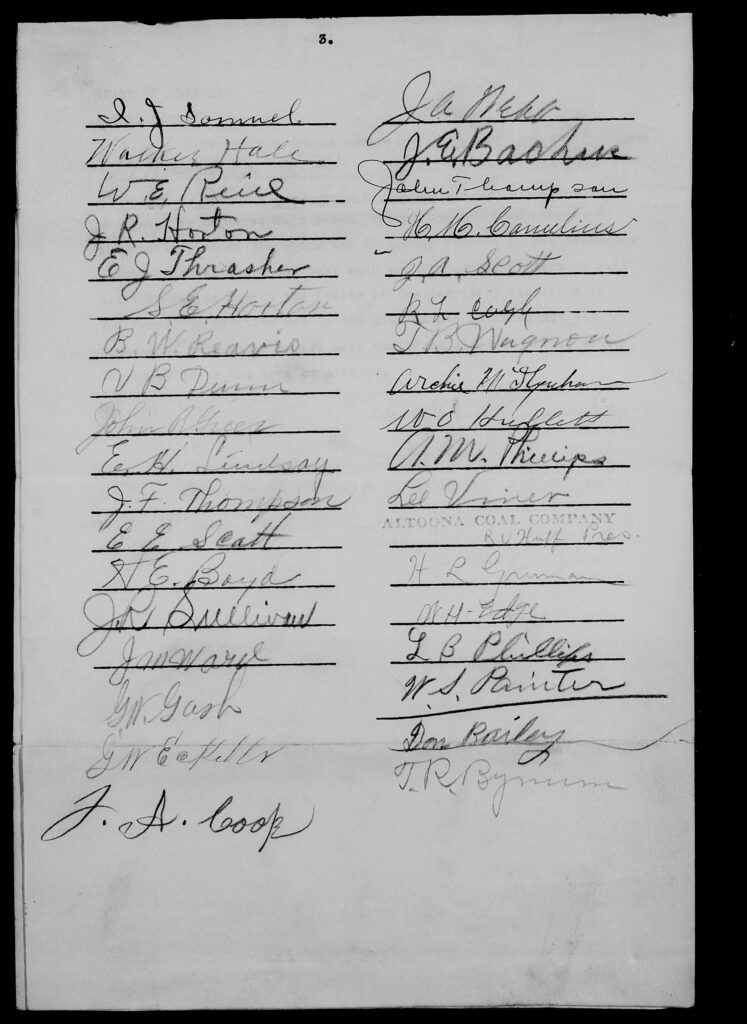
| I.J. Samuel | J.A. Webb | Walker Hale |
| J.E. Bachus | W.E. Reid | John Thompson |
| J.R. Horton | H.M. Cornelius | E.J. Thrasher |
| J.A. Scott | S.E. Horton | R.L. Cagle |
| B.W. Reavis | T.B. Wagnon | V.N. Dunn |
| Archie M. McIlquham | John R. Greer | W.O. Hullett |
| E.H. Lindsey | Lee Vines | A.M. Phillips |
| J.F. Thompson | R.V. Huff (President, Altoona Coal Company) | E.E. Scott |
| H.L. Gruman | H.E. Boyd | W.H. Edge |
| J.R. Sullivan | J.M. Ward | L.B. Phillips |
| G.W. Gash | W.S. Painter | G.W. Eckles |
| Dan Bailey | T.R. Bynum | J.A. Cook |
The petition was personally delivered to the probate judge by Archie McIlquham, E.E. Scott, and T.B. Wagnon. who was both a notary and justice of the peace.[10] Despite delivery on the 26th, the petition wasn’t filed in the Etowah County Probate Court until July 2.[11] Judge L.L. Herzberg ordered an incorporation election to be held on August 1 at the schoolhouse. Walker Hale, A.M. Cornelius, and N.R. Saye were set as election managers, with T.B. Wagnon and A.M. Phillips as election inspectors. On Election Day, 44 voters cast their votes for reincorporation. Forty-three votes were for incorporation, and one vote was against incorporation. In a slight change, J.A. Webb and G.W. Eckles were election clerks on the day of election, while W.A. Green, B.W. Reavis, and Walker Hale served as election inspectors.[12]

| W. Hale | G.W. Eckles | J.A. Webb |
| B.W. Reavis | T.B. Wagnon | W.A. Green |
| G.W. Gash | W.L. Smith | John R. Greer |
| E.J. Thrasher | H.E. Boyd | J.R. Sullivan |
| J.E. Bachus | E.E. Scott | John Thomson |
| W.E. Reid | J.R. Horton | J.C. Dorman |
| W.M. Lee | W.L. Minshew | L.B. Phillips |
| S.E. Horton | J.A. Cook | Jack Dobbins |
| L.M. Harris | L.V. Huff | W.O. Hullett |
| T.G. Henson | H.M. Cornelius | V.B. Dunn |
| B.N. Reavis | A.J. Hullett | A. McIlquham |
| J.F. Whisenant | J.A. Scott | I.J. Samuels |
| Dan Bailey | J.A. Hopper | H.L. Gurman |
| T.R. Bynum | J.A. Denson | B.H. Ellison |
| I.S. Cook | L.T. Taylor |
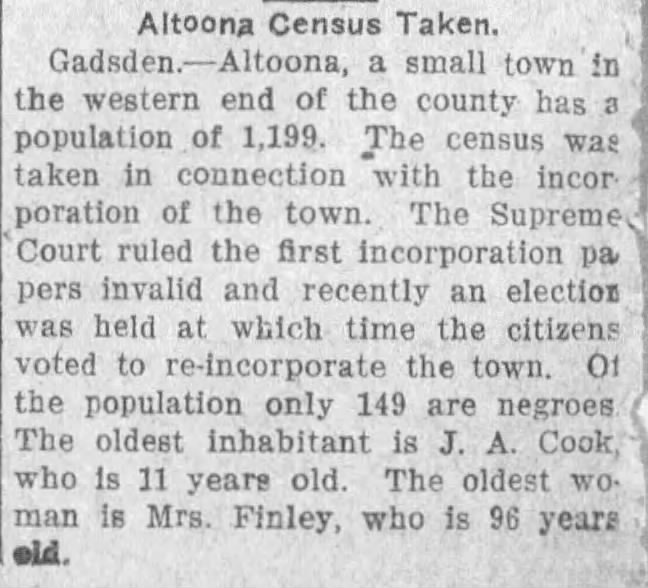
The official results of the election were recorded in the probate court on August 2nd. In the record, probate judge Herzberg ordered that an enumeration of the inhabitants of Altoona be conducted. The census takers were named as J.A. Webb and G.W. Eckles. Although the official results of the census were lost, news articles from the time reveal the total and some of the statistics. The population of Altoona in 1917 was 1,199.[13] Of the 1,199, 149 were African American, while J.A. Cook was the oldest citizen at 101 years old. A Mrs. Finley was the oldest woman at 96, and J.R. Horton had the largest family with 11 members. The oldest unmarried woman was 42, and the oldest unmarried man was 41.[14]
On August 7, upon reviewing the results of the census, the Probate Court ordered an election for mayor and council to be held on September 10, 1917.[15] J.F. Thompson, B.W. Reavis, and V.B. Dunn were appointed as inspectors with G.W. Eckles and J.A. Webb as election clerks. Hale and every member of the previous council ran unopposed. In total, 36 voters participated in the election, with Hale receiving all 36 votes for mayor and R.L. Cable received the same amount for council member. While no candidate received any votes against them, R.L. Gruman and L.T. Taylor received 35 votes, while Archie McIlquham totaled 34, and E.E. Scott ended up with 33 votes. Probate Judge Herzberg certified the election and recorded it in the Etowah County Probate minutes on September 12.
The following day, on the 13th, Probate Judge Herzberg presided over the first council of the reincorporated town. The minutes of this meeting appear on the opposite page of the June 21 meeting, the last meeting held before Altoona lost its charter.[16] Mayor Hale and the Councilmen were sworn in, and the meeting continued in much of the same way it did during their initial inauguration the previous October. John Thompson was reappointed as clerk, while I.J. Samuel and L.A. Kilpatrick were once again sworn in as health officers.[17] Appointment of a police chief was postponed until the following night, on September 14. The remaining minutes of the meeting record the order of drafting Ordinance #1, which was setting a business license schedule. Ordinance #2 was ordered, setting the Ad Valorem tax rate. Attention then turned to the topic of meat markets and butchers with a $10 license fee being levied on both. Ordinance #3 was drafted which placed a prohibition on the sale of meat without inspection by a licensed physician.
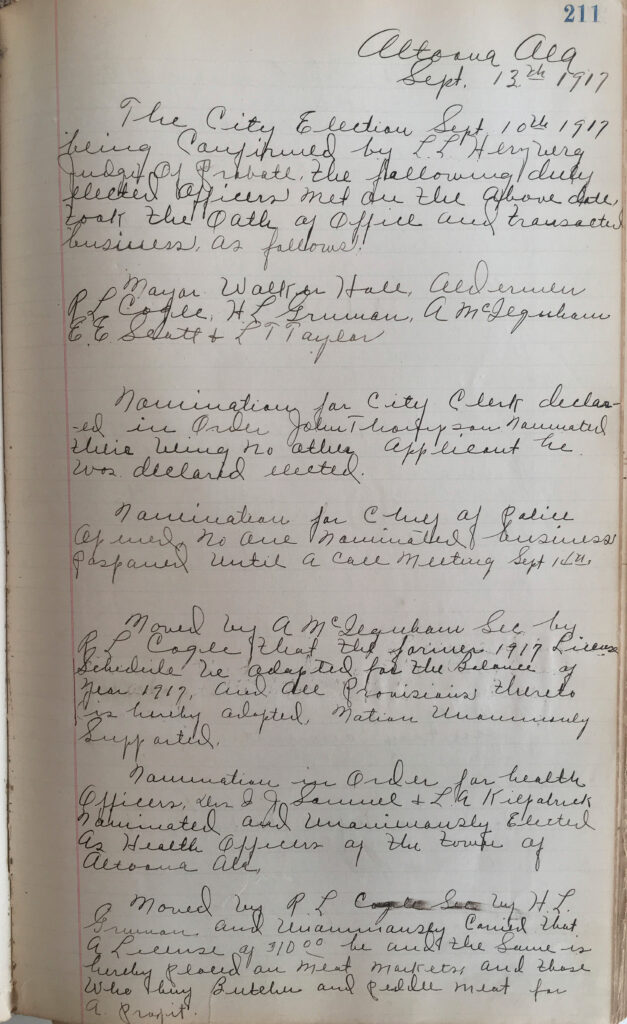
The meeting ended with the appointment of committees. H.L. Gruman (Chairman), E.E. Scott, and L.T. Taylor composed the finance committee. Scott (Chairman), Archie McIlquham, and Gruman composed the street committee, and McIlquham (Chairman), R.L. Cagle, and Taylor were members of the sanitary committee.
The following night, the council met once again to appoint a police chief and pass the three ordinances that were drafted.[18] Three nominations were made for chief, with W.D. Lee receiving three votes and becoming the new police chief. G.F. Muse and J.A. Webb were also nominated, receiving one vote each. All three ordinances were passed unanimously, and the meeting was closed. Altoona was once again up and running as a functioning town.
[1] Altoona Council Minutes 1910-1924, November 2, 1916, meeting.
[2] Altoona Town Council Minutes 1910-1924, January 18, 1917, meeting.
[3] Etowah County Probate Minute Book G, Page 298.
[4] “Status of Altoona settled by court,” 22 June 1917, The Gadsden Evening-Journal, P.1.
[5] “Appeal to Supreme Court of Alabama,” 7th Div-892, Alabama Department of Archives & History, ADAH-SC2347,
[6] Ibid, # 51.
[7] Lee, Lawrence, H., “Report of Cases Argued and Determined in the Supreme Court of Alabama during the October Term 1916-1917. Volume 200.
[8] “Altoona has forfeited charter,” 22 June 1917, The Gadsden Times P.1.
[9] Ibid., #51
[10] Etowah County Probate Admin Record 1910-1919, P. 8
[11] Etowah County Probate Case A-1-27. Loose files, Box 1, Folder 78.
[12] Ibid.
[13] “Altoona Census Taken,” 16 August 1917, The Gadsden Times, P.2.
[14] 10 August 1916, Birmingham Post-Herald, P.2.
[15] Ibid., #58.
[16] Altoona Town Council Minutes 1910-1924, September 13, 1917, meeting.
[17] Dr. J.H. Ellison who was previously a health officer was suffering from the effects of the flu and would pass away on September 26.
[18] Altoona Town Council Minutes 1910-1924, September 14, 1917, meeting.

Be First to Comment