WALKER HALE’S BACKGROUND
Walker Hale, the son of Stephen F. and Martha Mackey Hale, was born in Leesburg, Cherokee, County, Alabama, on September 11, 1875.[1] Stephen, a native of Virginia, fought in the Civil War in which he was wounded. After the conflict, he relocated to Alabama, where on December 7, 1867, he married Martha Mackey of Cherokee County. This union resulted in the birth of two daughters, Lavina and Augusta prior to the birth of Walker. After Walker, the family added two more daughters, Roxie and Eugenia.
At the close of the Civil War, Stephen entered the general merchandise business with his brother Ellis Hale.[2] This venture was undoubtedly influenced by their father, Fielden Hale, who himself was a merchant in Virginia.[3] The brothers business, located in Centre, ended after five years when Ellis began a political career.[4] Stephen later entered a partnership with a Wood and Paul F. Pratt to form a furniture business.[5] By 1903, he was under the employment of his cousin J.C. Hale.[6]
Undoubtedly, Walker would have grown up immersed in the mercantile and furniture business. His father’s role as a businessman would have provided and education and means that many other Cherokee County citizens were not able to achieve. This is correlated by the 1870 census, which lists Stephen with a personal estate valued at $1500.[7] On September 28, 1887, when Walker was 12-years old, the family was dealt a devastation blow upon the death of his mother, Martha.[8] Stephen would later remarry Florence Rudd on December 20, 1892.[9]
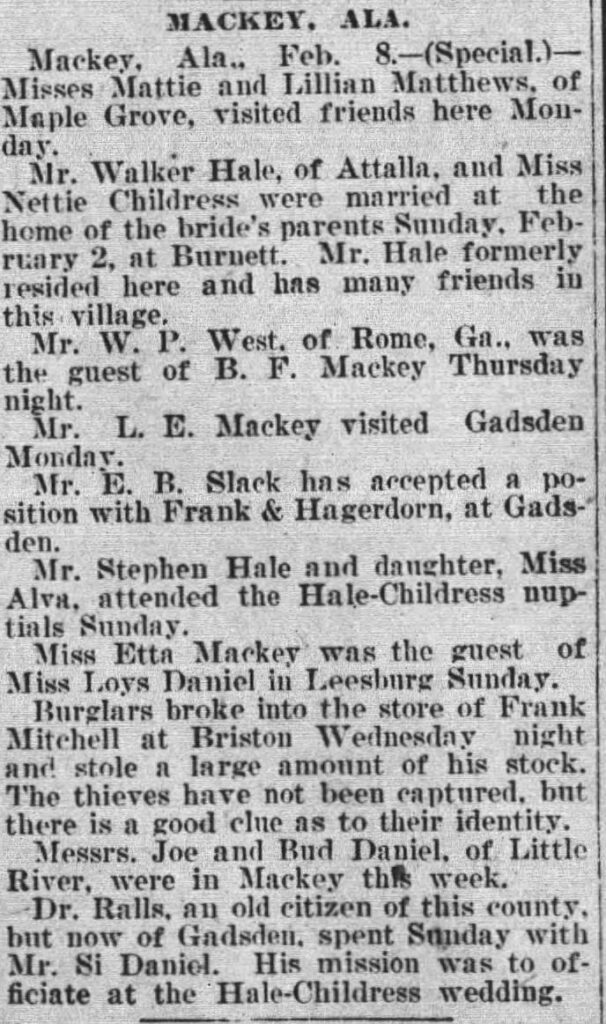
Events in Walker’s life from the death of his mother until 1902 are unknown. However, by the beginning of that year, he was in Rome, Georgia.[10] However, he was drawn back home to Cherokee County by Eva “Nettie” Childress, to whom he was married on February 8, 1902.[11] The news article announcing the marriage mentioned that the ceremony was performed by Dr. Ralls, a noted citizen of Gadsden. It continues to list Stephen’s residence as Attalla, while stating he was a former resident of Leesburg.
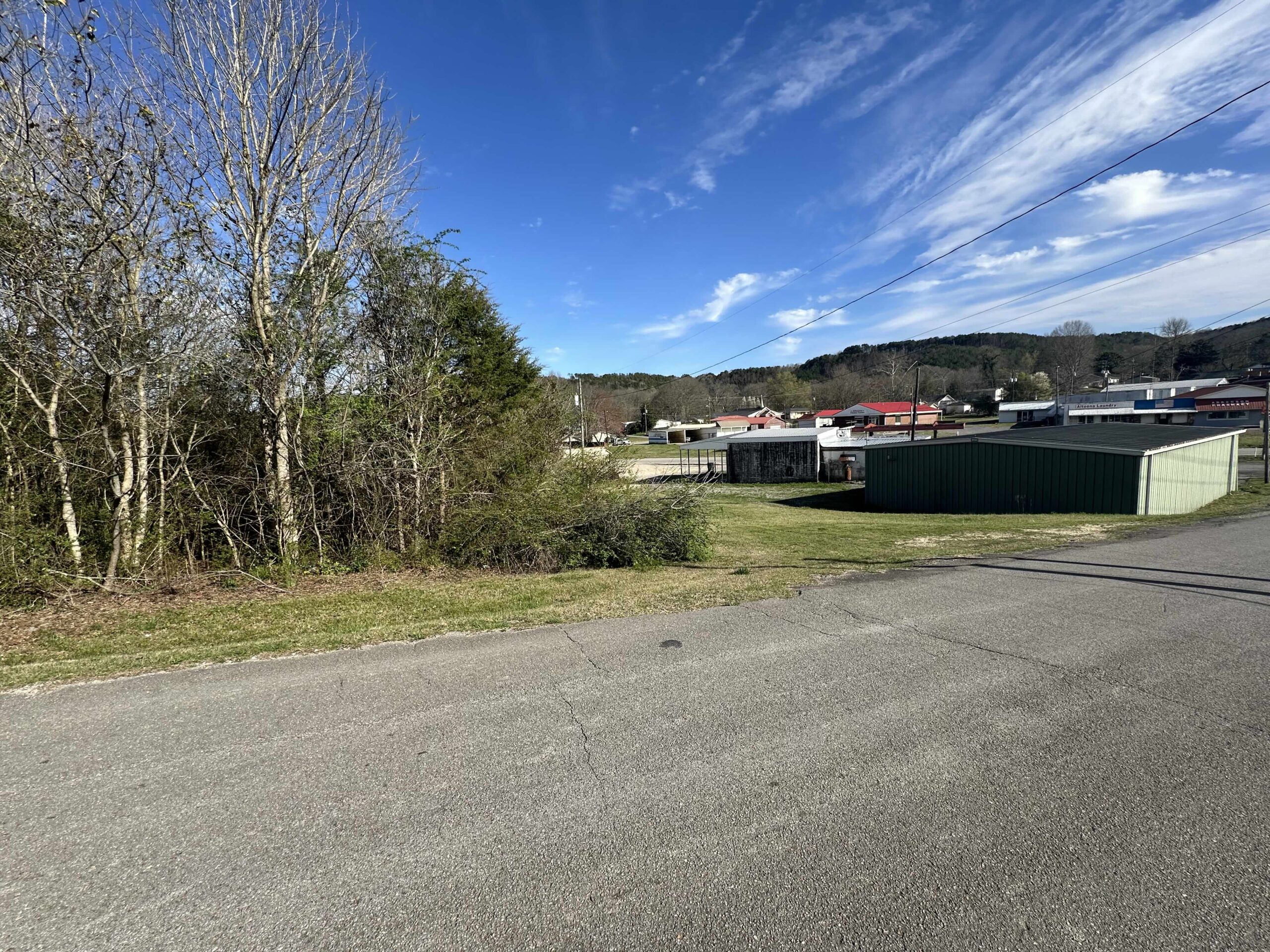
It appears that after their marriage, Walker and Nettie returned to Attalla where they resided. Walker found work with T.C. Banks, a prominent Attalla merchant.[12] In December 1903, the Coosa River News, reported that Stephen Hale and family were relocating to Altoona, where they would now reside.[13] This report is corroborated a November purchase of ½ a residential lot in Altoona.[14] This lot was located on the east side of 6th Avenue between College and Main Streets. Today, it is marked by the grassy area between Butch Davis’ old parts house and the white residence on the corner of College and 6th. While no record exists to prove a house was on the lot at the time of purchase, by 1912 a 4-room house was on the property.
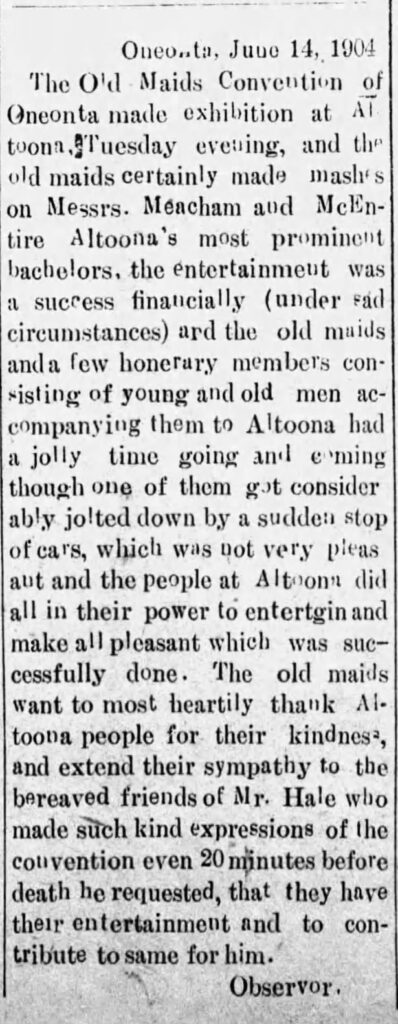
Unfortunately, the elder Hale’s time in Altoona was cut short. On Friday, June 10, 1904, Stephen began to feel unwell.[15] The feeling continued through the weekend, but it was not thought to be a serious illness. However, by the afternoon of the 14th, he was “seized with a chill.” [16] Despite this, he sent a message to the Old Maids Convention in Altoona to “Have their entertainment and contribute the same for him.”[17] About 20 minutes later, Hale died at his home. He was interred two days later at Cedar Hill Cemetery in Leesburg. Although his time in Altoona was short, his obituary noted that he was a consistent member of the Methodist Church.
WALKER HALE IN ALTOONA
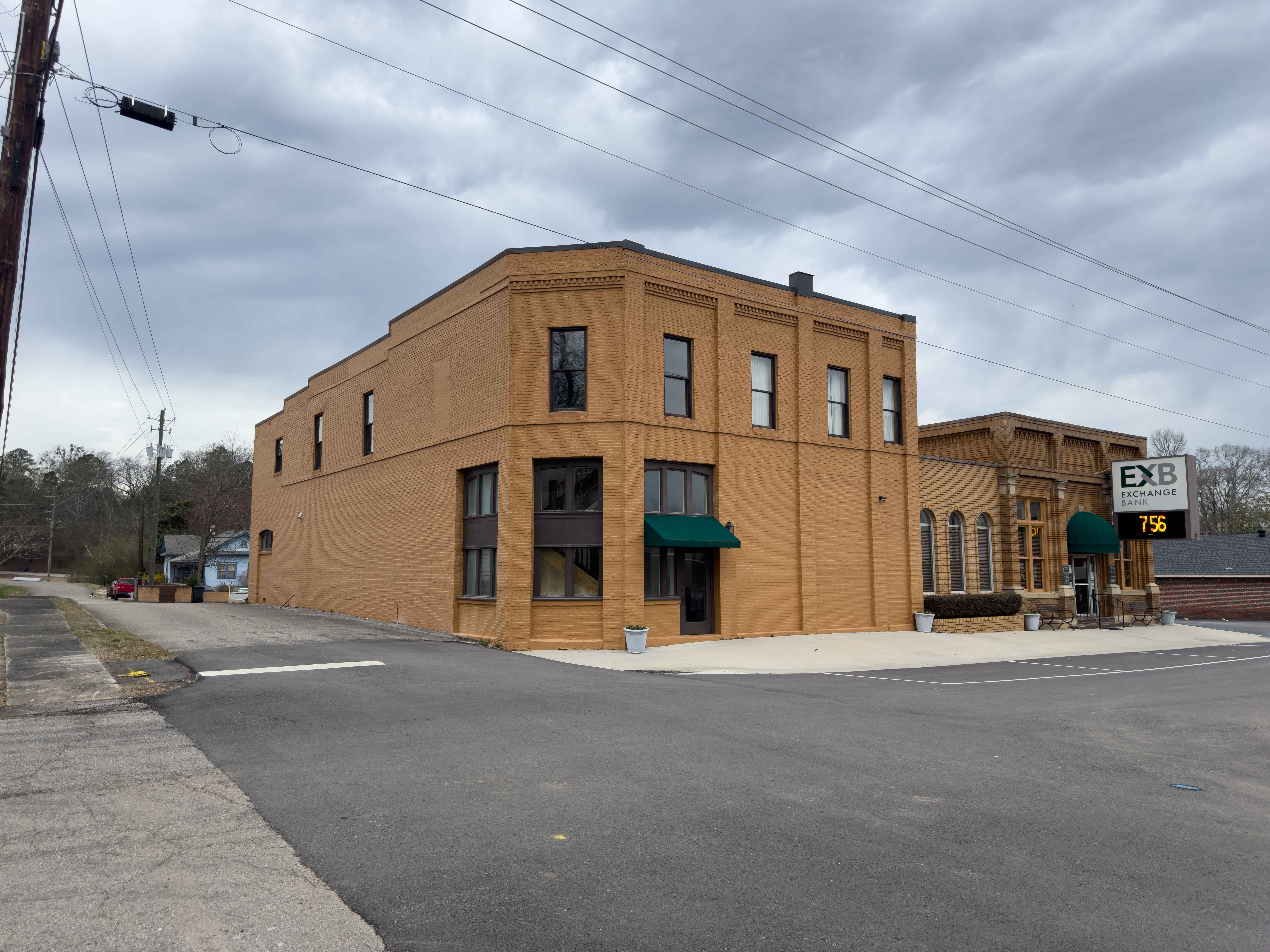
Walker Hale came to Altoona around the same time as his father. Walker and Nettie Hale are listed as charter members of the First United Methodist Church when it was founded on April 5, 1903, indicating that Walker may have preceded his father in coming to the young town.[18] A deed between Walker and A.D. Thompson, just two weeks after Stephen obtained property, records the purchase of a ½ lot on the corner of 6th Avenue and Blount Street. This would become the future site of the brick building that still stands to this day.[19] This building would be home to the Hale Furniture Company. It was the first brick building in the downtown section of Altoona when all the other buildings were wood or tin covered structures. It’s construction, aided by a bucket brigade, allowed it to survive the devastating 1913 fire that consumed the other structures in the area.[20] Unfortunately, it’s unclear when Hale started the business. The company does not appear on business reports until early 1909.[21] While he appears on business reports as the sole owner, there are indications that he may have been in a partnership or received financing from his brother-in-law William Hampton Childress.[22] By 1910, ad valorem records show that Hale now resided in his father’s house on 6th Avenue.[23]
Hale’s first appearance in association with Altoona comes in the form of a 1904 Altoona Odd Fellow lodge celebration.[24] The advertisement for the event lists Hale as an usher. In November 1905, B.H. Ellison subdivided his property creating the Ellison Subdivision to Altoona.[25] Some of his streets were named in honor of prominent Altoonaites. One of these was Hale Street. However, it’s not recorded whether this was named as a tribute for Stephen or Walker Hale. During this time, Hale also began to expand his family with the birth of his son Lewis Hale in 1904. This was followed by the birth of daughter Jeanne in 1906, son Stephen Jr, in 1907, Marcus in 1908, Mary Ruth in 1909, Walker “Spike” Hale in 1913, and Donald Hale in 1915.[26]
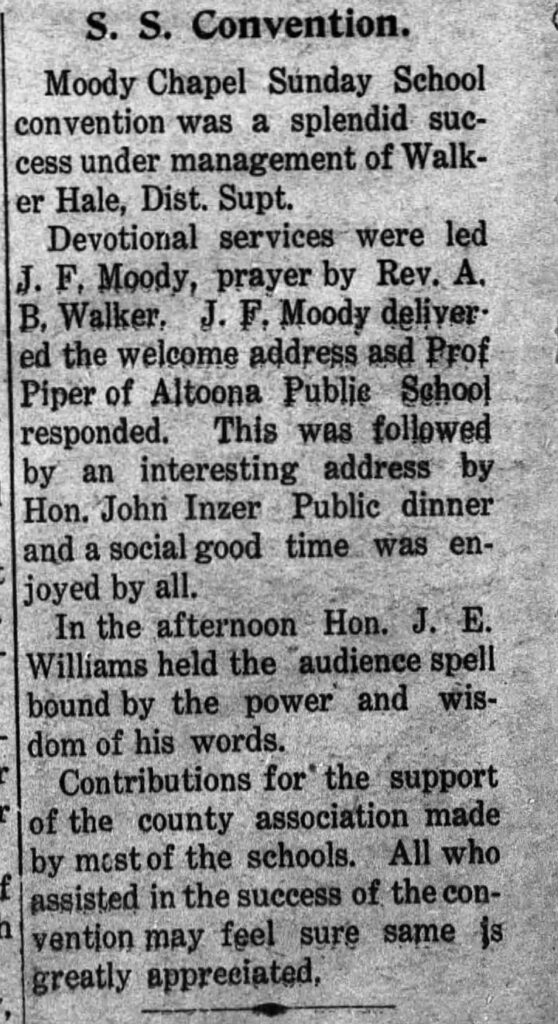
Hale was also socially and religiously engaged during the time. He was a member of the Altoona Dramatic Company and appeared in the play “Alabama” which was performed in Oneonta.[27] Outside of his membership with the Odd Fellows, he was also a member of the Knights of Pythias and served as president of the local lodge.[28] By 1912, his service with the Pythias extended to secretary and treasurer of the district.[29] Hale was also an active mason, joining the W.T. Underwood Lodge No. 612 between 1904 and 1908.[30] He would later serve as master of the lodge for three consecutive years, 1909-1911. Like his father, Hale was a prominent member of the Methodist Church. His role in the church expanded well beyond the local level with the appointment as District. #7 president at the 1910 Sunday School Convention.[31] Re-Election followed in 1912.[32] That November, Hale and District #7 hosted the county Sunday school convention at Moody’s Chapel, an event that was held in high regard.[33]
POLITICAL CAREER AND ELECTION AS MAYOR
Despite his dedicated service to the Sunday school and Pythias, there is nothing to suggest that Hale showed any interest in the politics of early Altoona. His lone appearance in the records comes from 1905, when Hale appeared as a returning officer in one of the numerous elections to incorporate the town.[34] When Altoona’s incorporation finally passed in 1908 Hale was not among those who participated in the election or received votes for office.[35] However, he and his family were counted on the election census, and Walker appeared on the list of registered voters.
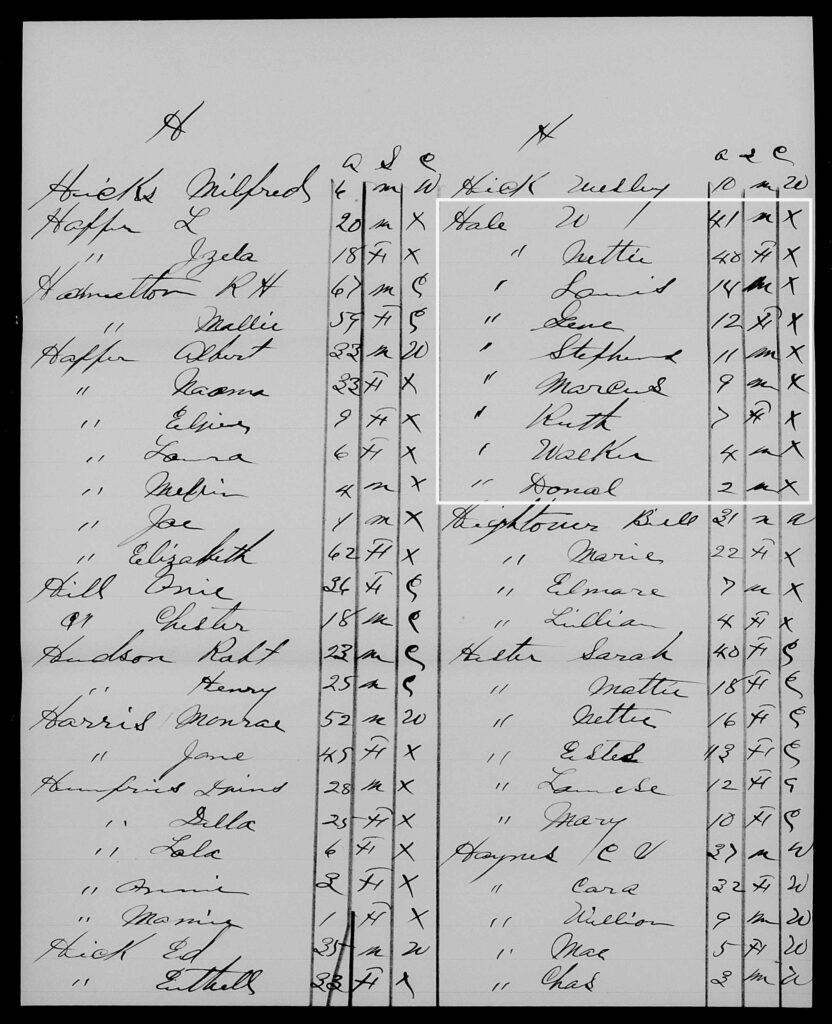
By 1910, Hale’s absence among Altoona’s town fathers began to shift. He appeared as an election manager in Altoona during the spring of 1910.[36] The following year, Hale was appointed by the town council as a trustee of the Altoona School.[37] In the spring of 1912, Hale once again worked as an election manager of the Democratic primary, the party affiliation that he would carry throughout his life.[38]
On September 18, 1916, Walker Hale was elected as the 7th mayor of Altoona.[39] His election, in retrospect, appears as somewhat of a surprise. Between 1912 and the notice of election results in 1916, Hale does not appear in any recorded source as playing a role in political affairs. His name is not mentioned in any capacity within the town minutes, nor does he appear as an election manager after 1912.
His surprise entry into the mayor’s race could be explained by a general dislike of the previous administration. It appears that Hale was the head of a group of individuals who wished to completely revamp the look of the town’s leadership. This is supported by a Birmingham Post-Herald article on Etowah County elections which states, “Walker Hale and his entire board of aldermen were elected in Altoona, defeating the present mayor and board by a 2 to 1 vote.”[40] While the results of the council election are no longer recorded, Hale beat G.W. Gash for mayor by a vote of 56 to 14.[41] Gash had previously served as a councilman under the last administration of mayor C.S. Ellison. Since the council results are no longer available, its unknown if any of the previous members ran against “Hale and his entire board.” However, councilman W.A. Green was previously a councilman in the C.S. Ellison administration. With the scarcity of details, it’s unknown whether Gash was a holdover from that administration or if he was one of “Hale’s men.” The other councilmen who were elected are R.L. Cable, L.T. Taylor, A. McIlquham, and E.E. Scott.
While it’s possible that Hale and his councilmen were elected in response to the unpopularity of the previous administration, the transfer of power does not indicate the presence of friction between the two administrations. On October 16, 1916, the old administration called the council meeting to order and conducted the last business of the old administration.[42] After an adjournment to allow Hale and his board to take office, the meeting resumed under the new council. The first two actions by the council were to unanimously nominate and confirm two members of the earlier administration, town clerk John Thompson, and police chief J.M. Waid. Three council committees were also created: the finance committee, the street committee, and the sanitary committee.
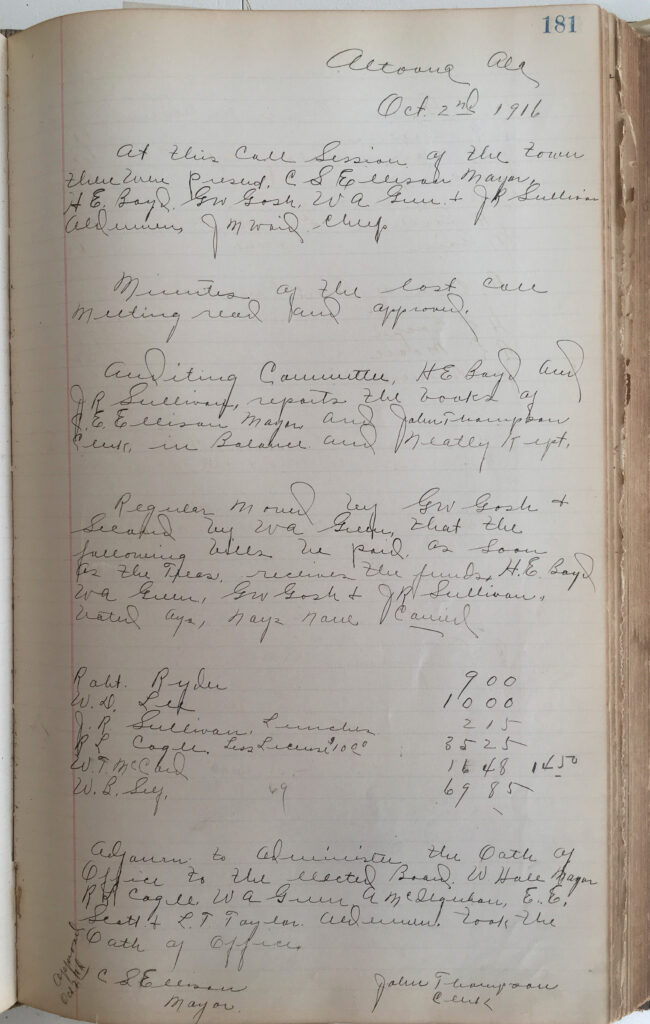
The Hale administration would end up being one of the more progressive times in the history of Altoona. This began with the first full council meeting in which a resolution was passed declaring October 9 as a town cleanup and fire prevention day. The meeting continued with an order to fix the mountain road and the numerous bridges in town. This meeting also saw the appointment of three town doctors, L.A. Kilpatrick, J.H. Ellison, and I.J. Samuel as health officers.[43] As the work of the town continued into the fall and winter, other items were tackled, such as the appointment of two additional police officers.[44] Prior to this time, Altoona only had one officer, the police chief. The extra officers may have been necessary to control an apparent dog problem in town. In the spring of 1917, the officers were instructed to notify all dog owners that unless a dog tax was paid within 10 days, the dogs were to be killed.[45]
Sanitation was a big priority of the Hale administration. In November 1916, Ordinance #68 was passed which prohibited the sale of fresh meats without an inspection by one of the town health officers.[46] This was followed by the addition of a $10 business license fee assessed to meat markets in January 1917.[47] During this time, the Town of Altoona had a public toilet, which was referred to as the “City Closet.” It’s not recorded where the restroom was located, but other entries in later council minutes reveal that they were often built over creeks or ditches to allow the expedient departure of waste. This was likely case with the “City Closet” and why the council ordered it be abolished in October 1916.[48]
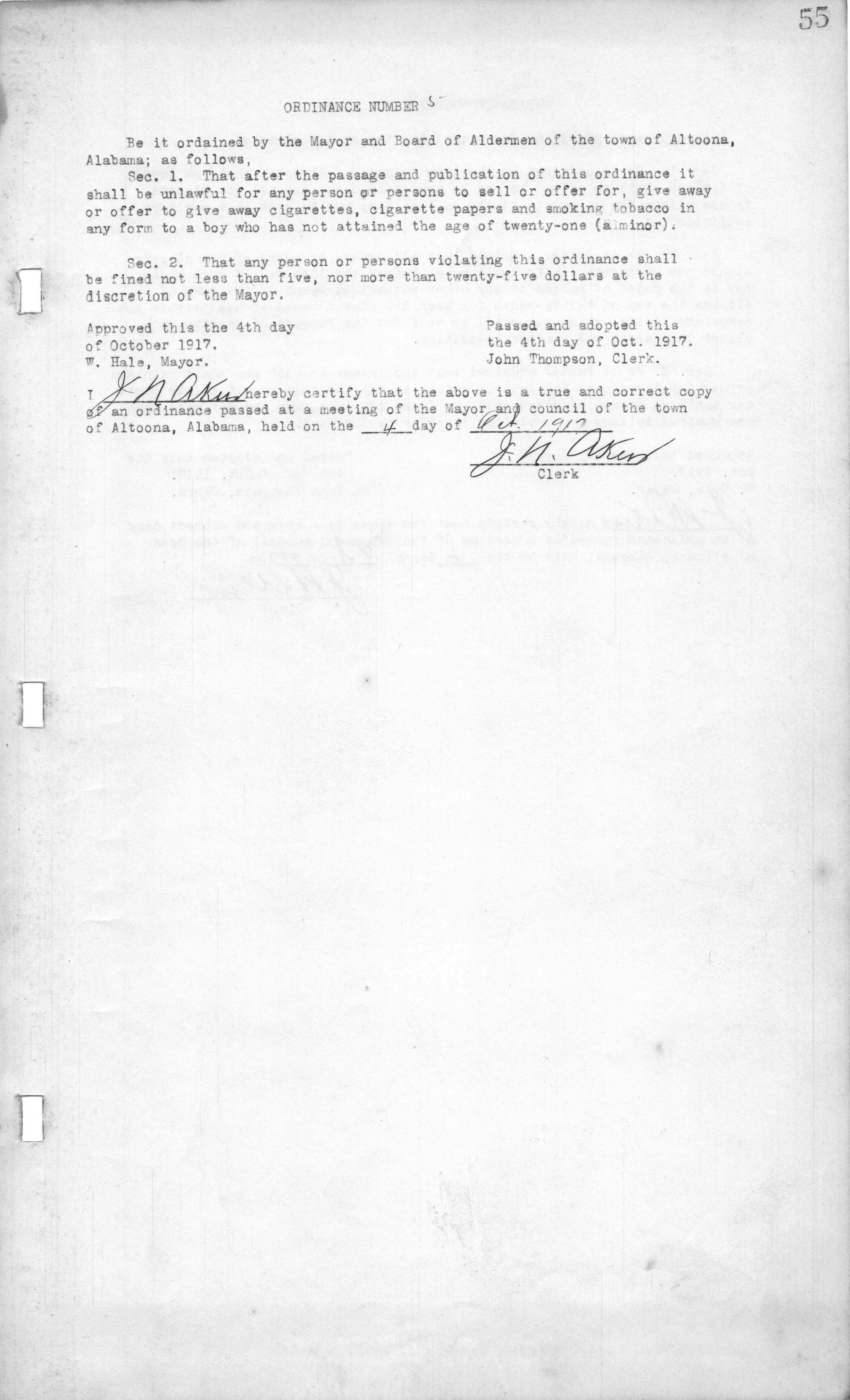
Other ordinances and notices that were made during Hale’s tenure include raising the license on dentists to $15 a year, as well as assessing license fees on a repair shop, auto dealer, and garage for the first time.[49] Western Union Telegraph Company had a reduction in their business license, from $10 to $1.[50] Like the addition of automotive dealers and garages to the license schedule, as a sign of the times, the Hale administration also passed Ordinance #71, limiting the speed limit in town to 8 mph.[51] Perhaps the most surprising ordinance passed by the Hale administration during this time was Ordinance #71, which limited the sale of cigarettes and tobacco to minors under the age of 21.[52]
[1] Yvonne Kays Family Tree, Ancestry. https://www.ancestry.com/family-tree/person/tree/158806606/person/282077118537/facts
[2] “Stephen Hale is Gone.”, 17 June 1904, The Coosa River News, Centre, Alabama. P.1.
[3] 1860 US Census, Carroll County, Virginia, P.1.
[4] “Ellis Hale Dead.” 31 May 1889, The Coosa River News, Centre, Alabama, P.3.
[5] “Local Items.” 23 March 1883, The Coosa River News, Centre, Alabama, P.3.
[6] Coosa River News, 17 June 1904, P.1.
[7] $46,000 in 2024.
[8] Yvonne Kays Family Tree.
[9] Ancestry.com. Alabama, U.S., County Marriage Records, 1805-1967 [database on-line]. Ancestry.com Operations, Inc., 2016
[10] 2 January 1902, Cherokee Harmonizer, Centre, Alabama, P.2.
[11] “Mackey, Ala.” 8 February 1902, The Chattanooga News, P.11.
[12] “Attalla, Ala,” 4 January 1902, The Chattanooga News, P.9.
[13] 4 December 1903, The Coosa River News, Centre, Alabama, P.1.
[14] Stephen & Florence Hale from W.R. and Virginia Jones. 11/19/1903. Etowah County Deed Book 3-A-220. PIN: 2427292.
[15] “Stephen Hale is Gone,” 17 June 1904, The Coosa River News, Centre, Alabama. P.1.
[16] “Sudden Chill Takes off Mr. Hale,” 15 June 1904, The Gadsden Times, P.1.
[17] 16 June 1904, The Southern Democrat, P.3.
[18] Cole, Ryan M. 100 years of Altoona: From coal to Cotton. Altoona, AL: Murphrees’ Hill Publishing, 2012, P.95.
[19] Walker Hale from W.D. & Lucy Debtor. 11/26/1903. Etowah County Deed Book 4-O-445. PIN: 2370240.
[20] “Altoona Suffers from a Destructive Blaze,” 15 November 1915, The Gadsden Times, P1.
[21] Dun and Bradstreet Reference Book, Vol. 163, part 1. January 1909. P.4.
[22] Records indicate that Childress never resided in Altoona. The circumstances evidence that he may have been a partner in the Hale Furniture Company comes from later records of an expanded partnership with W.O. Hullett and Archie McIlquham. Childress later played a role in White Furniture Company in Gadsden.
[23] Altoona Ad Valorem Tax Book 1910-1919. P.12
[24] “Anniversary Celebration I.O.O.F.,” 21 April 1904, The Southern Democrat, P.3.
[25] Elision Subdivision to Altoona, November 20, 1903, Etowah County Subdivision Plat B-9.
[26] https://www.findagrave.com/memorial/50473018/walker-hale
[27] “Alabama Did Come,” 20 June 1907, The Southern Democrat, P.1.
[28] “The Pythias had big time,” 19 August 1909, The Gadsden Times, P.1.
[29] “Pythias named Stewart master,” 18 April 1912, P.1.
[30] Ibid., #19, P.91.
[31] “District heads and districts announced,” 3 September 1910, The Gadsden Times, P.1.
[32] “McCord Elected S.S. President for Etowah,” 29 August 1912, The Gadsden Times, P.1.
[33] “S.S. Convention,” 14 November 1912, The Southern Democrat, P.6.
[34] “Altoona News Items Town to Incorporate,” 6 October 1905, The Gadsden Times, P.1.
[35] 1908 Altoona Incorporation Papers, Etowah County Probate Records, Etowah County Courthouse.
[36] 11 April 1910, The Gadsden Times, P.1.
[37] “Altoona News,” 25 May 1911, P.8.
[38] Managers named for democratic primaries,” 12 March 1912, The Gadsden Times, P.2.
[39] “Altoona.” 19 September 1919, The Gadsden Times, P.1.
[40] “Defeated candidate for mayor wants investigation of 18 votes,” 20 September 1916, Birmingham Post-Herald P.3.
[41] “Altoona,” 19 September 1916, The Gadsden Times, P.1.
[42] Altoona Council Minutes 1910-1924, October 2, 1916, meeting.
[43] Altoona Council Minutes 1910-1924, October 5, 1916, meeting.
[44] Altoona Council Minutes 1910-1924, October 19, 1916, meeting.
[45] Altoona Council Minutes 1910-1927, March 15, 1917, meeting.
[46] Altoona Council Minutes 1910-1924, November 11, 1916, meeting.
[47] Altoona Council Minutes 1910-1924, January 4, 1917, meeting.
[48] Ibid., #39
[49] Altoona Council Minutes 1910-1924, February 15, 1917, meeting, December 7, 1916, meeting.
[50] Ibid., #40.
[51] Ibid. #41.
[52] Ibid, #41.

Be First to Comment