Among the most prominent families in Bristow Cove were the Avery’s. The patriarch, Peter, has a history that is well documented, and somewhat of a legend. Sons, David, Allen, and Henry all played significant roles in early Blount County. Despite this, their time in Bristow Cove remains largely a mystery.
Peter Avery
Peter Avery is a name associated with several landmarks and organizations in East-Central Tennessee. A DAR chapter, middle school, history and marketing organization, and the “Historic Avery Trace” signage which can be found along certain Tennessee roadways.[1]
Avery was born in Poughkeepsie, New York during the Winter of 1738 and Spring 1739. His parents, Meyer (Nehemiah) and Dorcas Avery has him baptized in the Dutch Reform Church in Poughkeepsie on May 26, 1739.[2]
Avery next appears on a June 1761 enlistment record. A muster roll shows that Avery served in Capt. Isaac Terbush’s company in Dutchess County, New York. It describes him as, “age 22; born Dutchess County; Cordwainer by trade; fair complexion; Grey eyes; fair hair.”[3]
Peter Avery married Mary Yaple on June 20, 1778, in the Old Dutch Church in Kingston, New York. Their marriage banns read, “Peter Efferli, j.m. born in Dutchess Co. and Maria Jebbel, born in Pennsylvanie and both residing in Bakatakan[Paka- takan].”[4] The marriage bore 11 children, three daughters (Tabitha, Elizabeth, and Jane) and eight sons (Nicholas, Peter Jr., John, David, James, Ruben, Henry, and Allen).
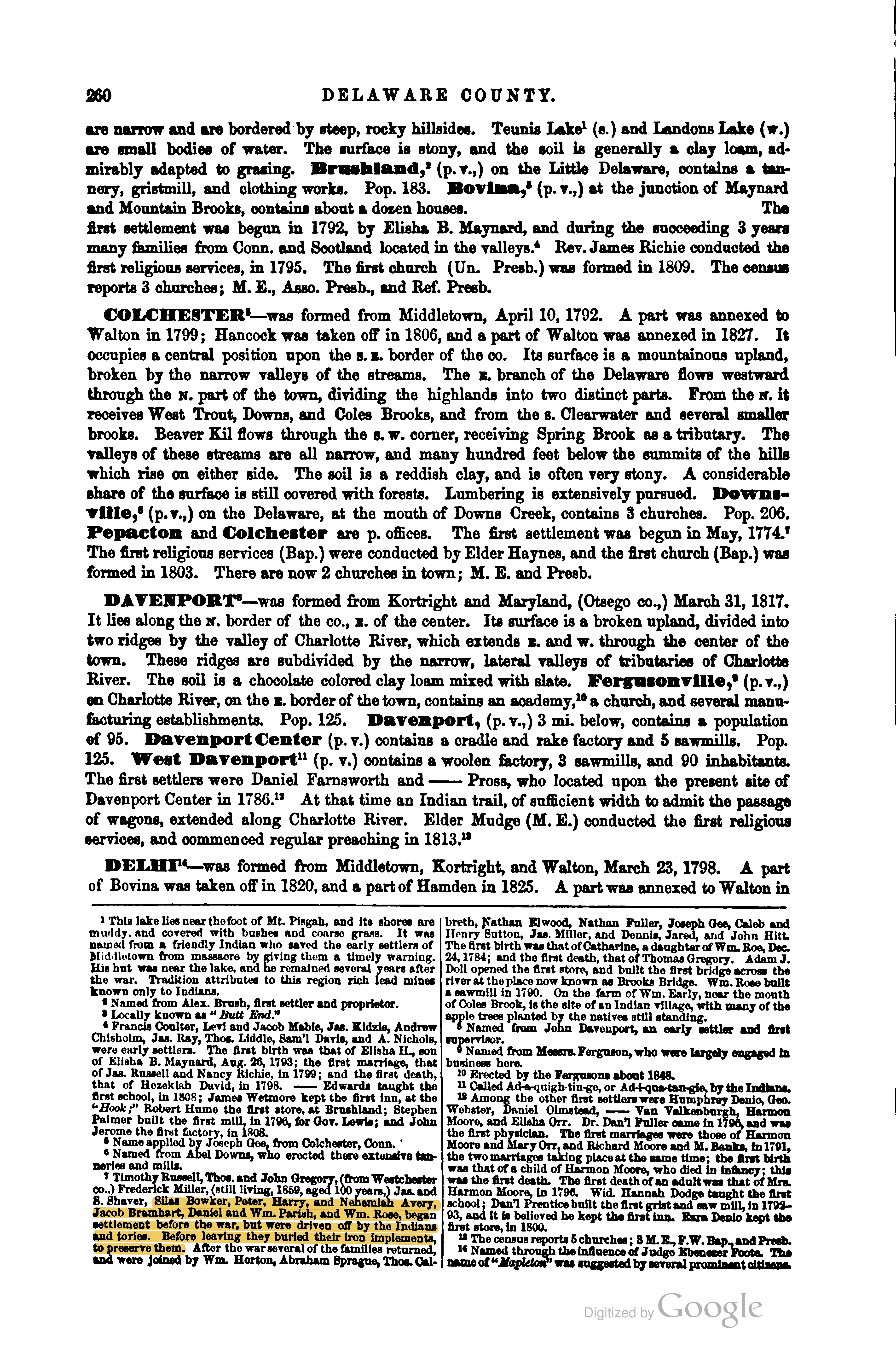
Shortly after his marriage, Avery entered service in the Revolutionary War. His time as a patriot was under Lt. Col. Newkerk in Col. John Cantine’s regiment of the Ulster County, New York militia.[5] The exact nature of Avery’s service is unknown, but Cantine’s regiment was called into service at different periods to repel the incursions of the enemy.[6] J.P. French, am early historian of New York notes that, “Peter, Harry, and Nehemiah Avery (among others) began settlement before the was (American Revolution), but were driven off by the Indians and Tories. Before leaving they buried their iron implements to preserve them.”[7]
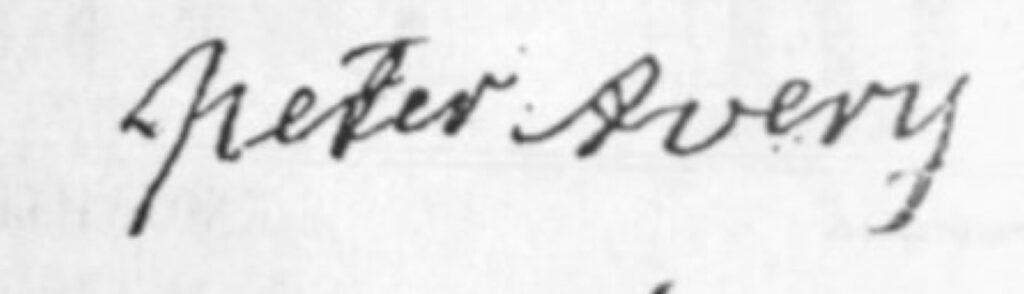
Tradition holds that soon after marriage and enlistment, Avery and his family moved to Virginia with the help of Mary’s brother, John Yaple.[8] The Virginia connection is seemingly confirmed by Avery’s children, Nicholas (1782) and Elizabeth (1784) who both show Virginia as their birthplaces on census records.[9] Despite this, no other record connecting the Avery’s to Virginia has been found. In fact, the next official record pertaining to Avery does not appear until 1789. That document, in which his signature appears, is a petition to the North Carolina legislature.[10]
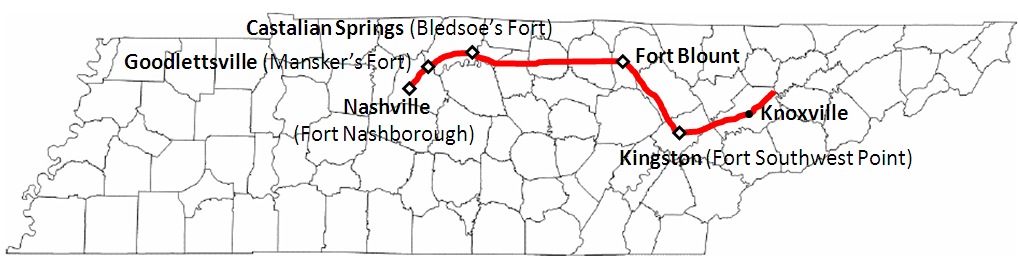
The lack of official records brings into question the first gray area of Peter Avery’s life. The aforementioned “Historic Avery Trace” signage along Tennessee roadways, hearkens back to a 1787 North Carolina road act which designated the original trace said to be cut out by Peter Avery.[11] However, Avery is not mentioned in the act, nor has any period correspondence or documents placed him as being associated with the road during the time period.
The initial road act, in which a road, ten feet wide, and fit for the passage of wagons and carts, from Clinch mountain to Nashville, was passed in November 1786. Work began during the spring of 1787, under a Major Evans. However, by November, work was halted due to lack of money and supplies. He then marched his men to Kentucky where they were furloughed.[12] Based on this initial failure, the North Carolina assembly passed a second act in an attempt to cut a road. This second act was successful, and the “Cumberland Road” was officially opened in September 1788.[13]
With neither of these acts or associated paperwork mentioning Peter Avery, how does he connect to the road that would eventually bear his name? One theory is that Peter was connected to Waighstill Avery, North Carolina Attorney General.[14] However, despite the same surname, no familiar connection has been made between to two Avery men. The traditional connection between Peter Avery and the trace comes from Roane County, Tennessee historian, Captain W.E. McElwee. McElwee, states that Peter, residing in Washington District, led John Sevier on expeditions and acquired the nickname, “Old Compass Head.”[15] Unfortunately, McElwee did not give any sources for these statements and no record of Avery being in Washington District has been found. The first source connecting Avery to the route is from an 1814 Roane County, Tennessee property survey which mentions “where Avery’s great road crosses (White’s) creek.”[16] A second 1832 survey in Morgan County, Tennessee states, “…eighty poles northwest from where the old Avery road intersects the old walton road.”[17] Unfortunately, Avery’s true connection to the trace that bears his name is impossible to prove, one way or the other.
Avery’s first Tennessee record is a 1795 Knox County lawsuit, which he later withdrew.[18] He then shows up three years later in an 1898 transaction in which he deeds his 19-year-old daughter Tabitha all of his property, improvements, and livestock for $100.[19] Avery is found on numerous Knox and Roane County, Tennessee records throughout the first decade of the 19th century. Lawsuits, land transactions, road orders, and tax records all bear his name.[20]
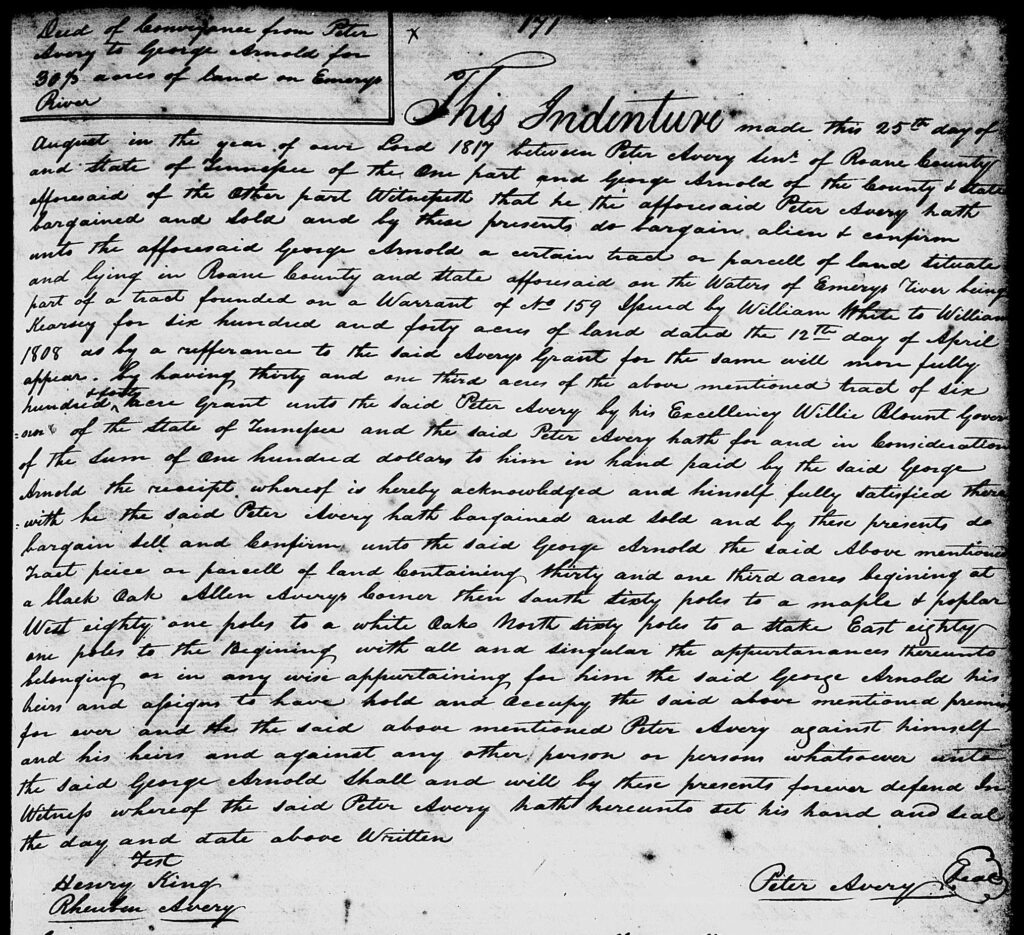
On August 17, 1817, Peter Avery’s name appears in the Tennessee Record books for the last time. The Roane County deed book records, Avery selling 301/2 acres to George Arnold.[21] Many historians, including Capt. W.E. McElwee wrongly believed that Peter Avery died in 1816 and was buried in Roane County.[22] However, examination of Roane County Court minutes reveals that it was his son, Peter, Jr. who passed away.[23] Peter Avery, Sr. was residing with several of his children in Bristow Cove by 1818.[24]
[1] Buchanan, Jane Gray. “A Study of Peter Avery, His Progeny, and Avery Trace.” Tennessee Ancestors, April 2007.
[2] Baptismal Roll, Dutch Reform Church, Poughkeepsie, New York.
[3] 1761 Militia Roll, New York State Historians Report, 1896
[4] Marriage Records, Old Dutch Church, Kingston, New York, No. 1640
[5] Return, dated September 2, 1778. Revolutionary War Service Records, National Archives, Washington D.C.
[6] Buchanan, Jane Gray. “A Study of Peter Avery, His Progeny, and Avery Trace.” Tennessee Ancestors, April 2007, P.20.
[7] J.P. French, Gazetteer of the State of New York, (Baltimore, MD., 1860), P.260
[8] Doris Yaple Geist and Roland Yaple, The Yaple Family in America, (Decorah, IA, 1990). P.319
[9] 1850 U.S. Census, Jackson County, Tennessee; 1850 U.S. Census, Wapello, Iowa; 1860 U.S. Census, Van Buren, Iowa.
[10] Cherel B. Henderson, comp., “Memorial of the Inhabitants So. Of French broad” Nov.-Dec., 1789. (Petition #12) North Carolina General Assembly Records, Nov.-Dec. 1789, Box 4, Folder 81, NC State Archives, Raleigh.
[11] Crownover, Danny. “Early Area Settlers Peter Avery and Son Allen.” The Messenger. February 21, 2014. https://gadsdenmessenger.com/2014/02/21/early-area-settlers-peter-avery-and-son-allen/.
[12] Walter Clark, ed., The State Records of North Carolina, Vol. XX, 1785-1788, (Wilmington, NC, 1994 [1902], vi-vii
[13] Walter Clark, ed., The State Records of North Carolina, Vol. XXIV, Laws, 1777-1788, (Wilmington, NC, 1994 [1905], P.913-914
[14] Buchanan, Jane Gray. “A Study of Peter Avery, His Progeny, and Avery Trace.” Tennessee Ancestors, April 2007. P.22
[15] Capt. W E. McElwee, “The Old Road: From Washington and Hamilton Districts to the Cumberland Settlements,” The American
Historical Magazine, Vol. 8 (October, 1903), 347-354.
[16] Robert L. Baj]ey, comp, Tennessee 4th Surveyers District Land Surveys, 1814-1824: Anderson, Bledsoe, Campbell, Morgan,
Overton, Rhea and Roane Counties, Tennessee. (Kingston, TN, 1996), P. 110
[17] Tennessee Land Surveys: Morgan County, 1832.
[18] Doris Yaple Geist and Roland Yaple, The Yaple Family in America, (Decorah, IA, 1990). P.319
[19] Blount County, Tennessee, Deed Book I, P. 12
[20] Buchanan, Jane Gray. “A Study of Peter Avery, His Progeny, and Avery Trace.” Tennessee Ancestors, April 2007. P.22
[21] Roane County Deed Book E, P. 171
[22] Capt. W. E. McElwee, Local History, The Rockwood [Tennessee] Times, March 10, 1910.
[23] Roane County, Tennessee, Court Minutes, 1816-1819, P. 78, 79,116,118,120
[24] Clarence Edwin Carter, comp., Territorial Papers of the United States, Vol. XVIII, Alabama Territory, (Washington, D. C., 1952), P.537

Be First to Comment