HALE’S SECOND (FIRST) TERM
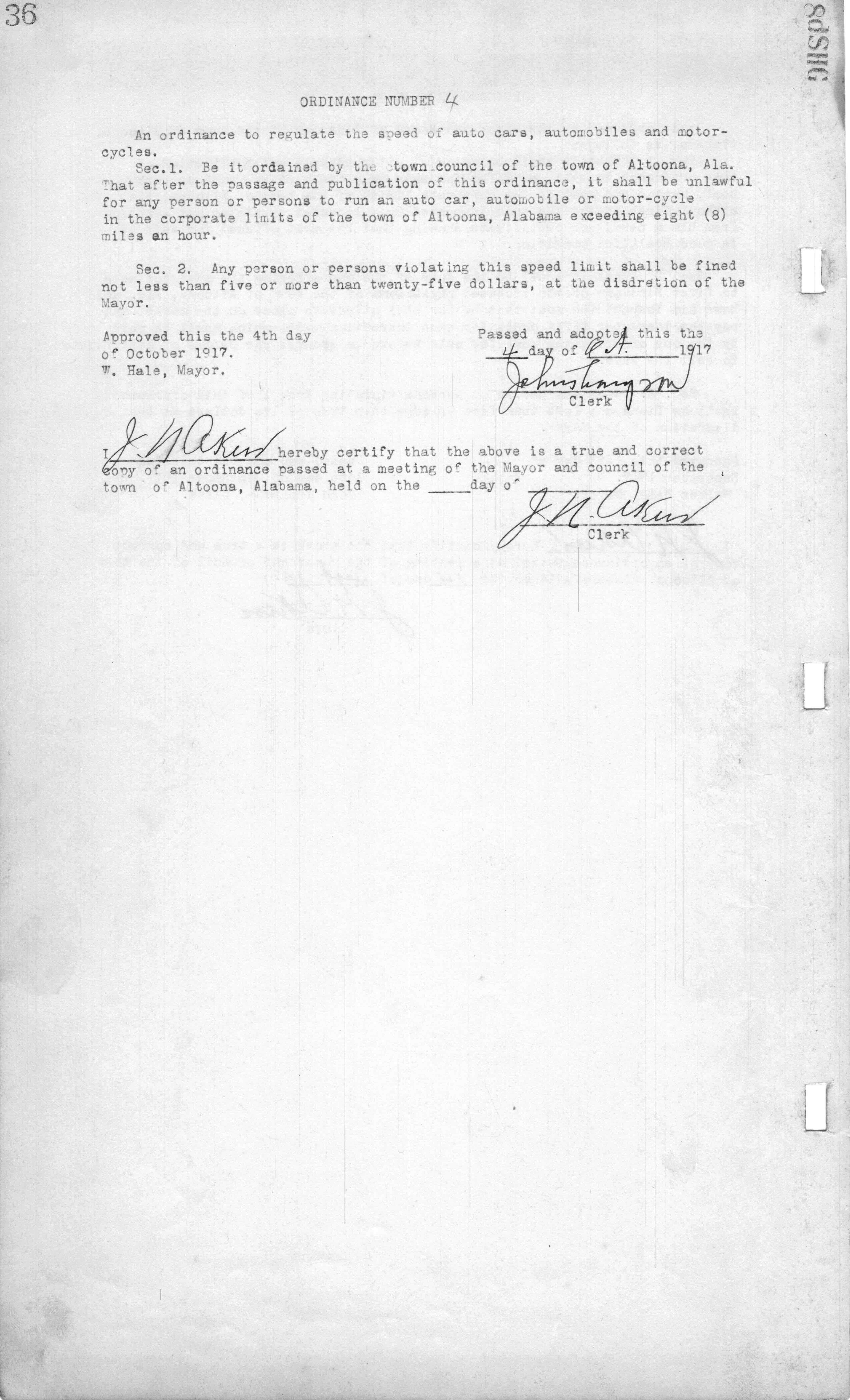
The first meeting in October included a blitz of ordinances, numbers 4-9. These ordinances included things such as setting a speed limit and age limits on tobacco. All these ordinances passed unanimously without discussion. The second October meeting placed a $10 license fee on cotton seed buyers. This meeting also included the election of a Mayor Pro-tempore. R.L. Cagle, H.L. Gruman, Archie McIlquham, and E.E. Scott all received one vote.[1] While it’s not recorded, it appears that each man cast a vote for himself. Since L.T. Taylor did not attend the meeting, (his attendance may have broken the tie, or followed suit and nominated himself), Mayor Hale broke the tie by casting his vote for E.E. Scott, making him the pro-term, and giving him the ability to serve as mayor in the absence of Hale. As fall turned to winter, council meetings became routine affairs without much discussion. An ordinance regulating the sale and use of fireworks was passed, followed by the adoption of a penal code.
HALE ADMINISRATION’S STANCE ON OPEN RANGE
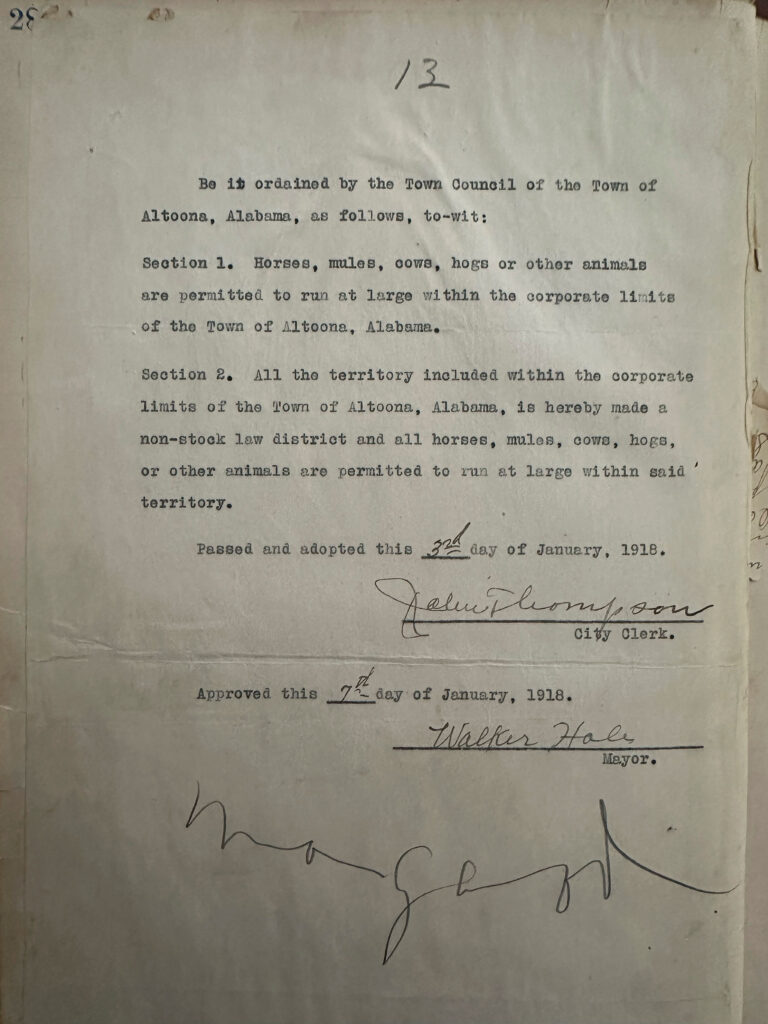
In January 1918, the council passed an unusual ordinance known as the “Anti-Stock Law Ordinance.”[2] During the latter part of the 19th and early 20th century, the stock-law movement swept through the area. For years, in fact since the start of both Blount and Etowah Counties, livestock were allowed to run free without any fencing to keep them restrained to their respective owner’s property. With the invention of barbed wire and the expansion of population centers, a debate over the question of the stock-laws began.
While Walnut Grove voted “no fence” in 1898, and the vote failed in Warrior Beat (a part of which would later become Altoona) in 1901, many areas began to require fencing to keep animals restricted to their property.[3] While no specific ordinance or stock law vote related to Altoona has been found, it is likely that a law was in place under a de facto nature set out by Underwood and the early leaders of the town prior to its original 1908 incorporation. Unlike Walnut Grove or other rural hubs such as Nix and Balm, Altoona was primarily a company town, founded in part due to the coal industry. By the time of the 1908 incorporation, Altoona had migrated from being just a company town to a full-fledged community. However, despite the rural setting, it was still primarily an industry-driven community. It’s likely that early founders such as Underwood and Rickles recognized this and purposely kept stock from grazing freely through the town. There are no reports of issues with any livestock found in the different articles on Altoona, and many early accounts talk about the structure and modern makeup of the growing community.

The January 3rd ordinance was very simply and deliberately worded: “All the territory included within the corporate limits of the Town of Altoona, Alabama, is hereby made a non-stock law district and all horses, mules, cows, hogs, or other animals are permitted to run at large within said territory.” There is no background on why this ordinance was drafted and brought before the council. It was not reported in any local paper and in hindsight, it appears to be an interesting stance to take. The stock law debates were well over a decade old at that point, and while there were areas where stock still roamed at large, it was almost unheard of in towns and cities during this time.
Like the background on what led to the passing of the ordinance, the overall response to the passage is also not known. However, on January 17, the next meeting immediately following the adoption of the ordinance, a “protest” against the anti-stock law was made by B.H. Ellison.[4] The minutes do not record his argument, or the council’s response. Instead, the mention of his protest is followed by the simple statement, “heard and complaint tabled.” The anti-stock law ordinance remained in effect until 1923 when it was replaced with an ordinance preventing the open range of animals and livestock within the town limits.[5]
HALE RESIGNS AS MAYOR
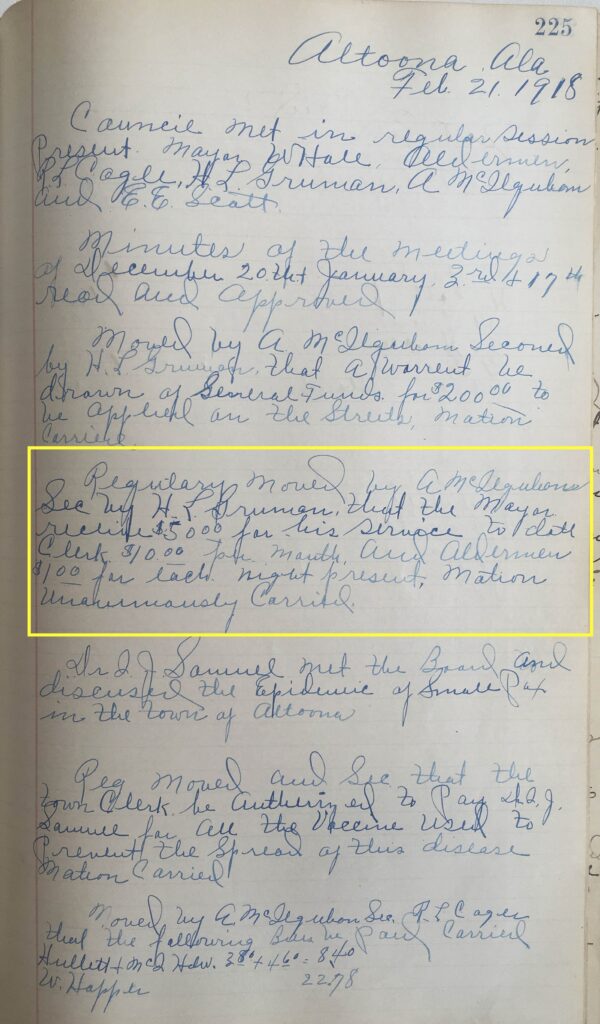
The February 21, 1918, council meeting would be Hale’s last as mayor. The next meeting on March 7, saw E.E. Scott resume the office as mayor as the pro-tempore, with Lee Vines taking his place on the council.[15] The minutes don’t record any formal resignation from Hale. However, it’s apparent that the Hale’s departure was well known as there wasn’t prior discussion to Vines nomination and confirmation. Additionally, at the February 21 meeting McIlquham made the motion, which was second by Gruman, to pay Hale $50 for his service as mayor, $10 to the clerk, and $1 to each councilman for each night present. After receiving a second the motion passed unanimously.
Hale’s time as mayor was brief, however, he led Altoona through the loss of its charter and the reincorporation of the town. His unopposed reelection made him the first official mayor of Altoona. His progressive administration fixed roads, cleaned up sanitation, regulated meats and butchers, restricted tobacco use, and set the town’s first speed limit. However, he also headed a council that made the unusual decision of implementing an anti-stock law.
HALE’S BUSINESS AND LEAVING ALTOONA
Prior to and outside of Hale’s term as mayor, his priority continued to be the operation of his business. On October 22, 1912, Hale and his wife formed the Altoona Hardware & Furniture Company with W.O. Hullett, Archie McIlquham, and W.H. Childress.[16] On the 1912 Ad Valorem Tax record, W.O. Hullett is shown as having paid the tax for the Hale Furniture Company and is listed as “agent” in the record.[17] Bradstreet records show that Hale Furniture Company changed to Hale Furniture & Hardware Company during the summer of 1912.[18]
It appears that prior to 1912, Hale owned the Hale Furniture Company outright or in a partnership with brother-in-law W.H. Childress. In October, Hale and Childress entered a partnership with Hullett & McIlquham which was, at least on paper, known as the Altoona Hardware & Furniture Company. However, during the duration of the partnership, Bradstreet records refer to it as Hale Furniture & Hardware Company. The same deed that referenced the 1912 formation of the Altoona Hardware & Furniture Company also shows the Hale Hardware & Furniture company as officially forming on April 18, 1914, with the same partners as Altoona Hardware & Furniture Company. This appears to be an official name change more than anything else, especially since the partners remained the same.

An examination of ad valorem records reveal that Hullett owned a storehouse in town as early as 1910.[19] This property was located at the present site of Anderson Pharmacy. However, unlike other Ad Valorem tax records it only lists the property and storehouse itself. Other storehouse records also show an entry for goods, which indicates that the storehouse was either vacant or leased to another business.
The third partner, and later councilman during Hale’s tenure as mayor is Archabald (Archie) McIlquham. Archie was born April 1869, in Scotland.[20] He arrived in the United States on December 22, 1886, aboard the ship Furnessia. McIlquham married Alice Bailey June 2, 1887, in Laurel County, Kentucky. He came to Altoona about 1910, where he was enumerated on the census as a foreman in the coal mines. By 1912, he owned two houses on the southwest corner of 7th Avenue and Blount Street in Altoona.[21] It appears that McIlquham had no prior experience in business and bought into the store as an alternative to a life in the mining industry.
The likely scenario is that Hale (with the possible the addition of Childress) was either in financial trouble or was in the position of expanding his business outside of just furniture. With ownership of a nice brick building on the corner of 6th Avenue and Blount Street, he partnered with his brother-in-law, Hullett, and McIlquham to expand into the hardware business.
The Hale Hardware & Furniture Company lasted three years. On November 1, 1915, Walker and Nettie Hale sold their interest in the firm for $1000.[22] This included the “stock of goods, wares, merchandise, fixtures, accounts, but not including any part of the furniture stock.” Also included was the property and brick building on the corner of Blount and 7th Avenue. The same day, Childress also sold his interest in the company for $635, leaving the last two partners renaming the business “Hullett & McIlquham Hardware Company.”[23]
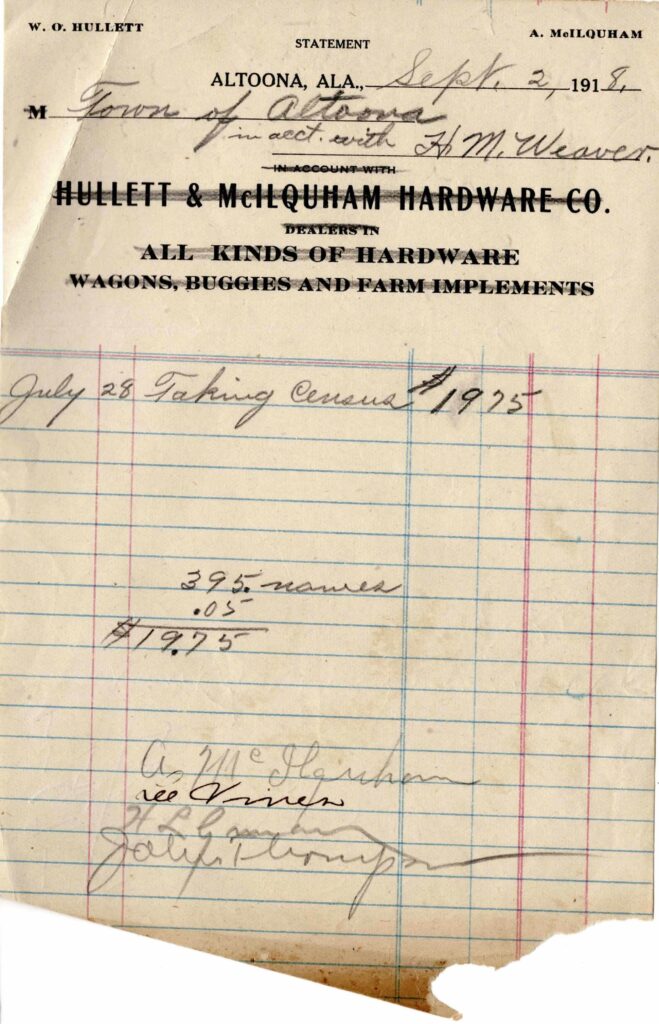
Hale continued to operate the Hale Furniture Company until 1917. It’s likely that Hale had a predetermined agreement with Hullett & McIlquham (or paid a lease) to sell the furniture out of the Hullett & McIlquham Hardware Company building. The exact date the Hale Furniture Company closed its doors in unknown. It’s likely he sold his stock or made an agreement with Hullett and McIlquham during the Summer of 1917 as the Hale Furniture Company remained on Bradstreet records until September.[24]
In April 1917, Hale purchased a business in Christoval, Texas.[25] Two years later, in April 1919, he sold 5 vacant lots in Altoona for $250.[26] The family home, originally purchased by his father, was sold to Horace and Florence K. Weaver in May 1920, for $1000.[27] With the sale of the property, the story of the Hale family in Altoona concluded.
WALKER HALE IN TEXAS
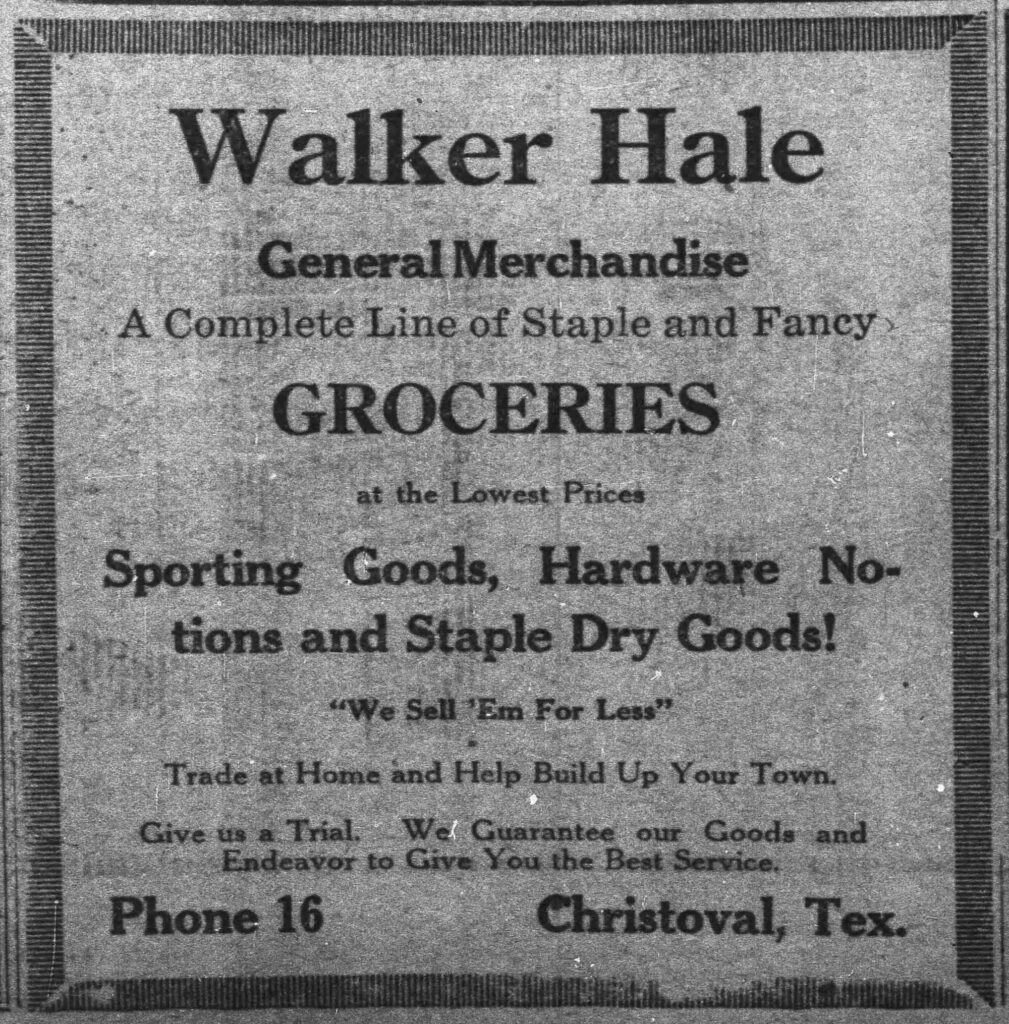
By April 1918, Walker Hale and family had relocated to San Angelo, Texas. The San Angelo Evening Standard reported that Hale purchased the stock of merchandise from Jeff P. Thomason, of Christoval, Texas.[28] The article continues by saying that the Hale family would occupy the “Sheppard cottage” until the “Rogers cottage” adjoining the Christoval store was vacated by Thomason. A later article states that while Hale purchased Thomason’s stock, his business was run out of the town’s old post office building.[29]

It appears that the Hale family quickly settled into Christoval society and the mercantile business that was now under the direction or Walker was quite successful. On January 1, 1920, he opened his store in a new location on the west side of Principal Street, in a building owned by W.S. Crawford. Unfortunately, this business would soon be struck by a familiar foe, fire. Unlike the 1913 blaze, Hale was not able to keep his business safe from destruction. Around 1AM on October 13, 1920, a fire broke out in Hale’s store.[30] It quickly consumed Hale’s store and spread next door to a meat market and cold drink stand of Paul Crawford. A local barber, W.C. Swart noticed the blaze and raised the alarm. Christoval citizens formed a bucket brigade that saved two adjoining buildings and contained the fire. Ironically, it was a bucket brigade that helped save Hale’s Altoona store during the 1913 fire.
The following week, Hale found himself in San Angelo to purchase fixtures to reopen his business back in the old post office building, which was across the street from the site of the fire. During his time in San Angelo, he reported that his stock of dry goods and groceries were valued at $10,000 and he only carried $3,500 worth of insurance.[31] Unfortunately, the cause of the fire was never determined.
After reopening, Hale’s business continued to thrive, allowing him the opportunity to immerse himself in the social fabric of Christoval. By 1921, he was president of the Christoval Board of City Development.[32] The recently formed board found itself busy with improving the town bathhouses, opening a hotel, and attracting new businesses to the community. Christoval was also home to an annual Confederate veteran reunion. The son and grandson of Confederate veterans, Hale threw himself into the events. He made the welcome address in 1922, 1923, and 1925, while he served on both the finance and reception committee in 1923 and 1924.[33]
Not unlike his time in Altoona, Hale was also active in both educational and spiritual endeavors. He was a member of the Christoval School Board, and a supporter of the expansion of the Christoval School which took place in 1925.[34] A devout Methodist, Hale also continued to be an active member within the First Methodist Church of Christoval. He was on the building committee and present when the cornerstone was laid for a new brick church building in 1926.[35] While it appears that Hale never held an elected position after his tenure as Altoona’s mayor, he remained a prominent Democrat. As early as 1924, he was a member of the Tom Green County Democratic Executive Committee.[36]
As Hale’s life in Christoval continued, his children grew up and found success of their own, while his store, which was later noted as the only general store in the southern part of the county, continued to thrive. After many years, he retired as a merchant and devoted his time to ranching and farming the old Sam DeLong ranch west of Christoval.[37] As he and Nettie aged, they eventually moved back into town where Walker continued to devote much of his time to poultry and gardening.
On Sunday, July 25, 1954, Hale suffered a heart attack and was rushed to Shannon Hospital in San Angelo, Texas. He remained in the hospital for a week, passing away during the early afternoon on Sunday, August 1.[38] Burial services were conducted the following day at 4 PM at the Christoval Methodist Church. Afterward, he was laid to rest in the Christoval Cemetery with the local Masonic lodge in charge of graveside services. Nettie remained in Christoval until December 19, 1973, when she passed away at 96 years of age.[39] She was laid rest next to her husband in Christoval Cemetery.

With a life spanning as business owner, mayor, farmer, church leader, and social leadership, Walker hale is best summed up by the last paragraph in his obituary, “Mr. Hale was active in church and community affairs. He was one of the trustees in building of the new Methodist church and served as Sunday school-superintendent for some time. He had served as president of the school board. He also was consistently interested in politics, although he never sought public office himself.” Except for that one time in Altoona…
[1] Altoona Town Council Minutes 1910-1924, October 18, 1917, meeting.
[2] Altoona Town Council Minutes 1910-1924, January 3, 1918, council, meeting. Ordinance #13, Altoona Ordinance Book 1909-1918.
[3] “Walnut Grove is for no fence,” 25 October 1898, The Gadsden Times, P.2.26 February 1901, The Gadsden Times, P.2.
[4] Altoona Town Council Minutes 1910-1924, January 17, 1918, council, meeting.
[5] Ordinance #15, Altoona Ordinance Book 1920s-1950s, ordinance passed April 5, 1923.
[6] Taylor was a town councilman.
[7] Altoona town Council Minute Book 1910-1924, February 21, 1918, meeting.
[8] “Smallpox cases reported in Anniston,” 16 December 1917, The Anniston Star, P.8.
[9] “Aggressive War Made on Disease,” 11 January 1918, The Birmingham News, P.5.
[10] “Smallpox is reported,” 27 December 1917, The Southern Democrat, P.2.
[11] “School children must be vaccinated,” 2 January 1918, Our Mountain Home, Talladega, Alabama, P.3.
[12] “Vaccination is urged in county,” 2 January 1918, The Birmingham News, P.2.
[13] “Drastic steps to check smallpox epidemic taken,” 10 February 1918, The Birmingham News, P.1.
[14] “No patients reported,” 20 March 1918, The Birmingham News, P.11.
[15] Ibid., #72.
[16] Etowah County Deed Book 3-I-72.
[17] Altoona Ad Valorem Tax Book 1910-1919, P.48.
[18] Dun and Bradstreet Reference Book, Vol. 181, part 1. July 1913. P.4.
[19] Altoona Ad Valorem Tax Book 1910-1919, P.12.
[20] Authors Email from Renee, Archie McIlquham, May 20, 2016.
[21] Altoona Ad Valorem Tax Book 1910-1919, P.52.
[22] Ibid., #83.
[23] Etowah County Deed Book 3-I-75.
[24] Dun and Bradstreet Reference Book, Vol. 198, part 1. September 1917. P.5.
[25] “Alabama Man Buys Christoval Business,” 16 April 1918, San Angelo Evening Standard, P.3.
[26] Etowah County Deed Book 3-V-409A
[27] Etowah County Deed Book 3-Y-588
[28] Ibid., #94
[29] “Fire destroys Two Christoval Stores,” 13 October 1920, San Angelo Evening Standard, P.1.
[30] Ibid., #99
[31] Ibid., #99
[32] 3 August 1921, San Angelo Evening Standard, P.1.
[33] “Veterans Gather,” 2 August 1922, San Angelo Evening Standard, P4. “Christoval Ready to Receive Vets,” 23 June 1923, San Angelo Evening Standard, P.1. “Confederated in Annual Re-union,” 16 July 1924, San Angelo Evening Standard, P.2. “Confederates open reunion,” 25 August 1925, San Angelo Evening Standard, P.1.
[34] “Bonds for School,” 1 June 1925, San Angelo Evening Standard, P.2.
[35] “Lay Corner Stone,” 3 May 1926, San Angelo Evening Standard, P.1.
[36] “Democrats Meet,” 23 April 1924, San Angelo Evening Standard, P.2.
[37] “Christoval Merchant Pioneer Dies,” 2 August 1954, San Angelo Evening Standard, P.2.
[38] Walker Hale Sr. (1875-1954) – Find a Grave…,” Find a Grave, accessed May 30, 2024, https://www.findagrave.com/memorial/50473018/walker-hale.
[39] “Hale funeral slated for today,” 20 December 1973, San Angelo Standard-Times, P.2.

Be First to Comment