David Hanby (D.H.) Crump was born on August 29, 1872, in Blount County, Alabama, to John Pinckney Crump (1840-1895) and Martha Jane Murphree (1841-1917).[1] He had siblings, including James Gabriel (1864-1916), William Ellis (1866-868), George Alexander (1868-1873), John Franklin (1870-1871), Annie (Flippen) (1875-1947), and Martha Jennie (Wester) (1877-1938).[2] Crump was a descendant of several pioneering Blount County Families: the Hanby’s, Crump’s and the Murphrees.[3] Crump grew up on, or was raised near the Crump farm on Blount County Road 15, which originally settled in 1841 by his grandparents, Reverend William Newton Crump and his wife, Martha Jane Hanby.[4]
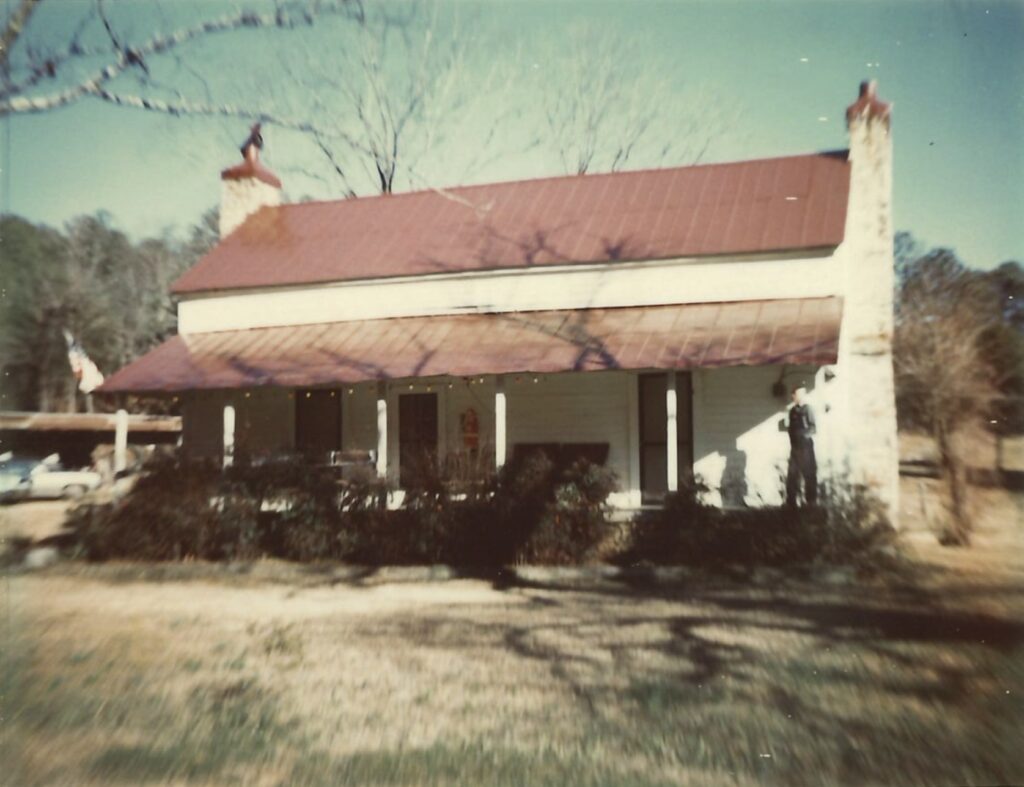
Details on Crump’s early life are unknown. A Southern Democrat article states that a 20-year-old Crump entered school in Oneonta in the fall of 1892.[5] At first glance, it appears that he was a pupil. However, an article from the next year, denotes him as “Prof. Hanby Crump,” indicating that he was a teacher.[6] On February 7, 1895, Crump’s father, John Pinckney Crump passed away, and was buried in the Crump Cemetery on the family farm. Although David Hanby was the youngest son, at the time of his father’s death he was the second oldest surviving child. The oldest surviving son, James Gabriel already had a family of his own, and the care of Crumps mother and sisters Martha Jane and Jennie, fell on his shoulders. This is evidenced by the fact that David Hanby wrote a letter to the editors of the Blount County News Dispatch, thanking the people of Oneonta for this kindness toward his father during his sickness.[7]
Crump served on a committee for memorial exercises at Liberty Church Cemetery on May 7, 1898.[8] A little over a week later, he accepted a position with Seale Brothers as a traveling salesman and left for Jackson County.[9] Either this position did not last long, or Crump was bi-vocational, as by June, he was Oneonta City Tax Collector.[10] The following year, Crump accepted a position as a clerk at the J.A. Brice Store in downtown Oneonta.[11] By 1900, at age 27, Crump was living in Oneonta with his mother and sister, Jennie Crump.[12]

In February 1901, he accepted a position to run the Underwood Mining Company Store in Altoona.[13] As a result, Crump, his mother, and his sister, relocated to the new mining town. [14] In bidding him farewell, the Southern Democrat noted, “Mr. Crump is a worthy young man and well qualified to fill the position.” Crump’s time with the Underwood Mining Company was both rewarding and tumultuous. While there are no records from the company store, his duties soon expanded beyond its four walls. In July 1902, the Etowah Lodge, No. 97, International Order of Odd Fellows held a picnic in Altoona. Crump was a member of the committee of arrangement, and the supervisor of the picnic grounds.[15] The Southern Democrat later remarked, “Mr. D.H. Crump supervisor of the picnic grounds deserves the highest commendation for his energetic attention to the many details involving the welfare and comfort of the people on this occasion.”

On July 19, Crump was named as the third postmaster at Altoona.[16] During this time, the post office was located at the Underwood Mining Company store in East Altoona. Crump’s appointment merged both the position of store superintendent and postmaster. His time as postmaster is marked by an attempt at cost-saving and efficiency within the post office in Altoona. Crump identified that the mail coming to Altoona was carried by express mail from Oneonta, with charges paid by the Underwood Coal Company at the rate of $0.50 per day. In a letter to W.T. Underwood (the owner of the Underwood Mining Company), he suggested that that the government should extend the mail route from Oneonta to Altoona.[17] Underwood responded by writing a letter to his brother, U.S. Senator Oscar Underwood, urging him to see if the Post Office could correct the perceived slight.[18] In an attempt to get the government to accept the change, Underwood stated that Altoona now had a population between 600-700, and that mail for Walnut Grove should be sent to Altoona instead of Oneonta. Unfortunately, it’s not known if the letter resulted in an immediate change or if it came later.
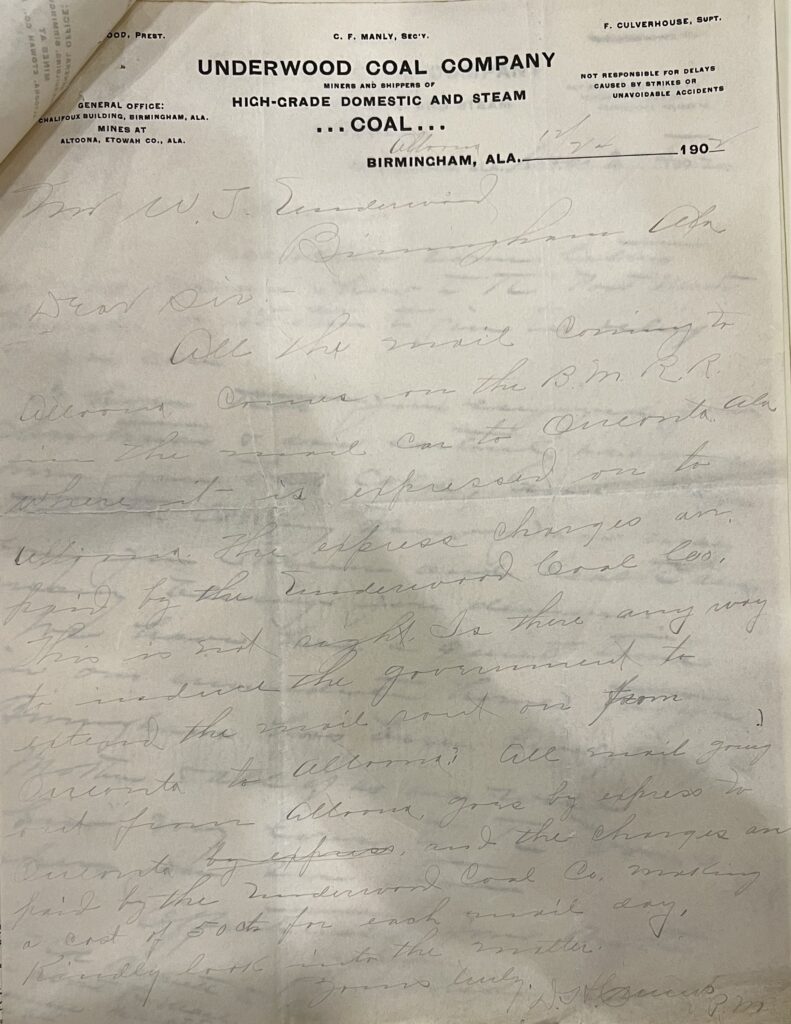
Just two years later, Crump’s time with the Underwood Coal Company would come to an end. In February 1904, W.T. Underwood enclosed D.H. Crump’s resignation as postmaster in a letter to his brother, Oscar.[19] Underwood did not describe any specific issues with Crump, other than he was suffering from a sickness. In a second letter dated March 2, Underwood expressed urgency, writing to his brother after receiving a notice that Crump’s resignation would not be accepted until a successor was appointed. [20]
Underwood then revealed the true issue at hand: “Crump has gotten his business affairs here into a bad shape; and while a can not say at this stage of my investigation how bad, this situation makes it very desirable to end his business connection with us.”
He later goes into even more detail: “Crumps trouble is in connection with his management of our store accounts, I do not know that there is anything wrong with his post office business. In fact, I do not know whether there is or is not.”
Ten days later, and upset with the delay, Underwood pens a third and final letter:[21] “It seems that the P.O. Department is going to be slow in appointing Crumps successor at Altoona. In view of this, and the disturbance? Of his making a change will you ask them to write him to the effect that he can turn the office over to his bondsmen if he wants to leave. The post office is in our store, and as I have dismissed him from our employ for cause, it is better that he should not be held there by post office duties.”
Underwood had to wait over two weeks for a successor to be appointed. Crump’s resignation was accepted and his term ended on March 29, 1904.[22] There do not appear to be any charges filed against Crump, and the exact nature of his mismanagement of the Underwood Store accounts remains unknown. Whatever the case may have been, it appears not to have had a lasting impact on Crump’s credibility or his standing in the community.
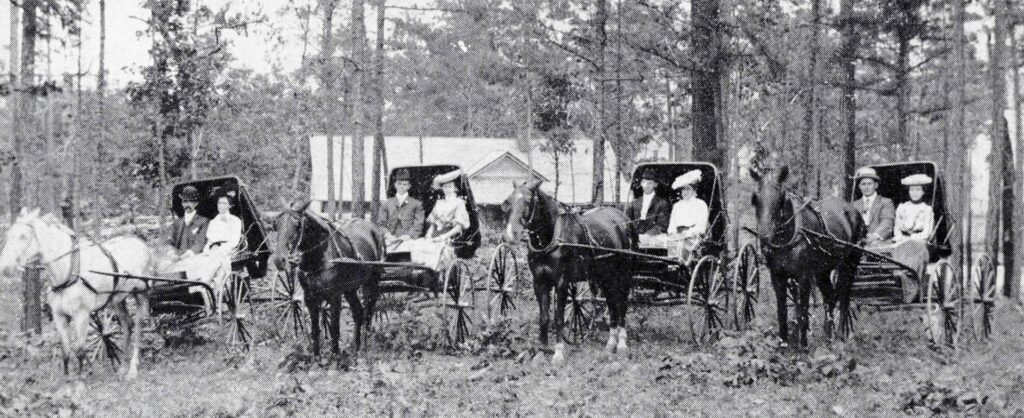
During this tenure with the Underwood Coal Company, Crump dedicated himself to his community and marriage. A May 1902 photo shows a group of Altoona’s beaux and belles paired up in buggies on their way to a foot-washing ceremony on Sand Mountain.[23] One of the couples included Crump and Miss Nan Lee. Despite the perceived courtship, Crump married Era E. Reavis in Walnut Grove on November 8, 1903.[24] Reavis was the daughter of Cherokee County native and longtime Walnut Grove resident Benjamin Wesley Reavis and his wife, Mary Fowler Reavis.[25]
In October 1902, Crump purchased a piece of land between the properties of the Underwood Coal Company and J.N. Rickles.[26] The lot was located on what is today the site of Second Baptist Church and its preschool. It’s hard to pinpoint if this was the site of Crump’s residence during this time. As an Underwood Coal Company employee who was manager of the company store, he likely had a nicer residence on company property than a regular miner. Unfortunately, Underwood had no surviving records, so Crump’s residence if he did live on company property, is unknown. However, after his separation from the company, the lot on 7th Avenue would have been the site of his residence.
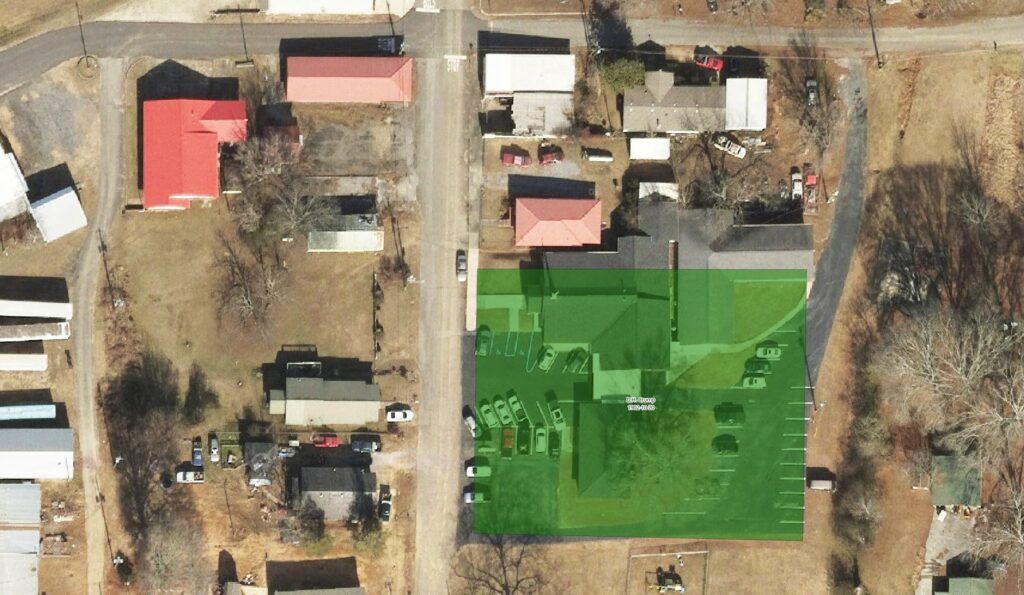
A little under two months after resigning his position as postmaster, an ad appeared in the Southern Democrat, with Crump proclaiming his new venture.[27] “NOTICE, I have opened a family grocery store here at Altoona, and I will appreciate any amount of business you may give me. I will buy your produce at market prices.” The following week, a second ad appeared.[28] “Friends, it has long been my desire for quite a long time to run a business of my own, and now I have the pleasure of inviting you to call at my store whenever it is your pleasure to do so. The favors which you have shown me in the past are not forgotten and I will continue to show you my appreciation of any amount of business you may give me by giving you mt prompt attention and making the prices right on everything in my line.” Where was Crump’s store located? A 1904 deed reveals that Crump purchased a lot on the north side of his residential property from W.J. Ellison.[29] Today, the site of his store would be 7113 7th Avenue, or what many residents would recognize as the area between Morgan’s Shoe Shop and Second Baptist Church.
Crump’s incident at the Underwood Company Store and resignation as postmaster apparently had no effect on public sentiment. In 1905, during one of Altoona’s numerous incorporation attempts, Crump was named an election inspector.[30] In October, Crump was noted among other Altoona residents who gave aid to the families of the miners who worked in the Virginia mines following its disastrous accident.[31] During this time, Crump was also a member of different fraternal organizations. He was the 19th member to join the W.T. Underwood Masonic Lodge No. 612, and he was a delegate of Altoona Lodge No. 236, Knights of Pythia, to the state convention in Birmingham in 1906.[32]
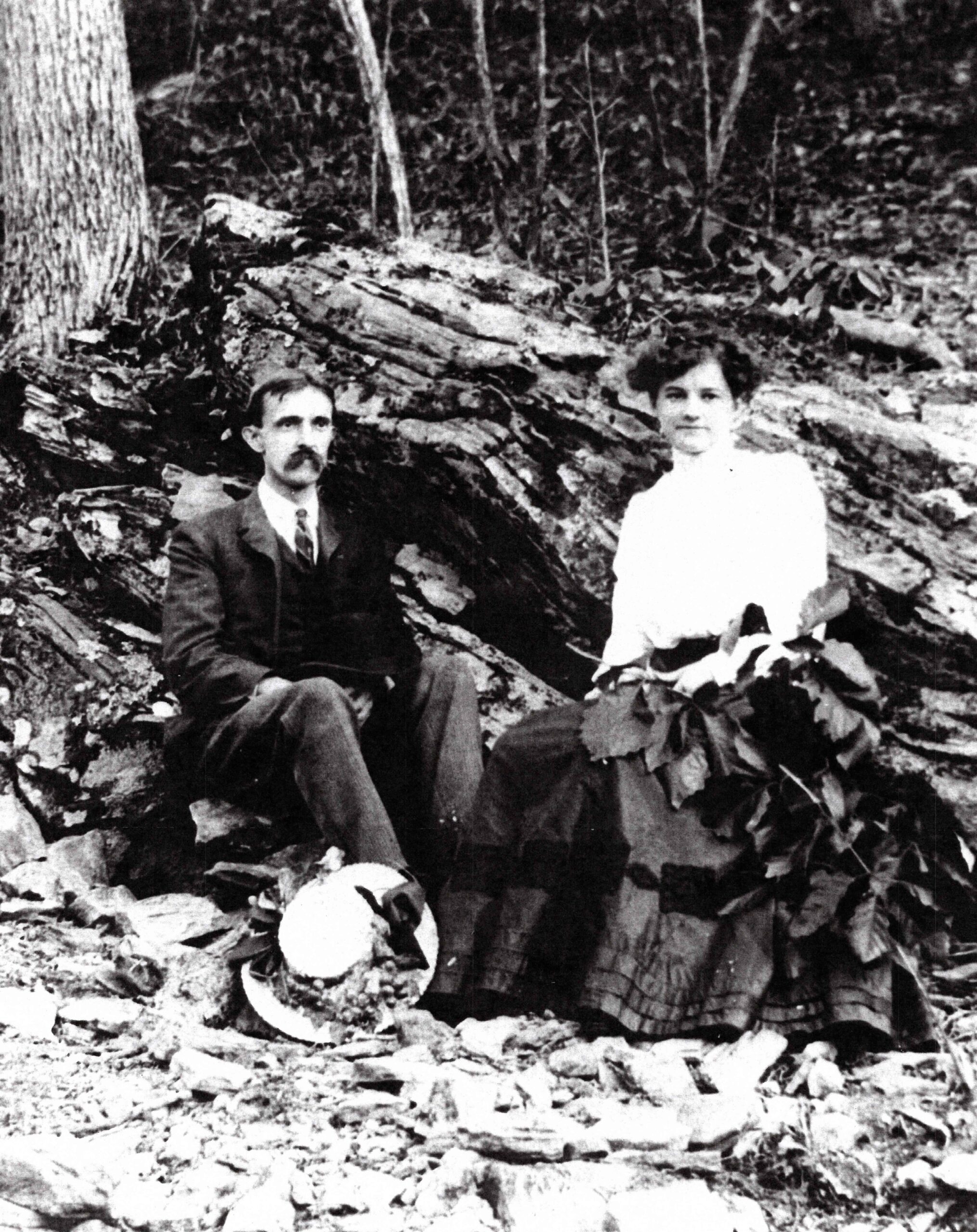
In themid-1900s, there is evidence that Crump expanded his business ventures Altoona. A 1906 mortgage document from D.H. Crump to R.B. Lacy lists the sale of horses, buggies, saddles, and a stable business in Altoona.[33] This also included a 40×75 foot building with an iron roof on the lot. Whether this included the stable on 6th Avenue in Altoona that was later destroyed in the 1913 fire or a stable on his 7th Avenue property is unknown. A 1907 Birmingham News snippet reveals that Crump operated a hotel under the name, “Crump Hotel” and offered free travel from the depot to his hotel, with a rate of $2.00 per night.[34] During this time, Crump may have exited the grocery business, as Lewis M. Thompson reported in October 1907 that Crump had reopened his mercantile business.[35]
In early 1908, Crump found himself once again named an election manager during one of Altoona’s incorporation elections.[36] This culminated in the final (and successful) incorporation vote in May 1908.[37] Among the articles on Altoona’s incorporation attempt, a small one-line sentence appears in a Southern Democrat news article on Altoona: “A child was born to D.H. Crump and his wife last week [February 17, 1908].”[38] While the birth of a child after several years of marriage would have been an delightful event, the occasion would soon turn tragic, and cast a dark shadow over Era Crump.[39]
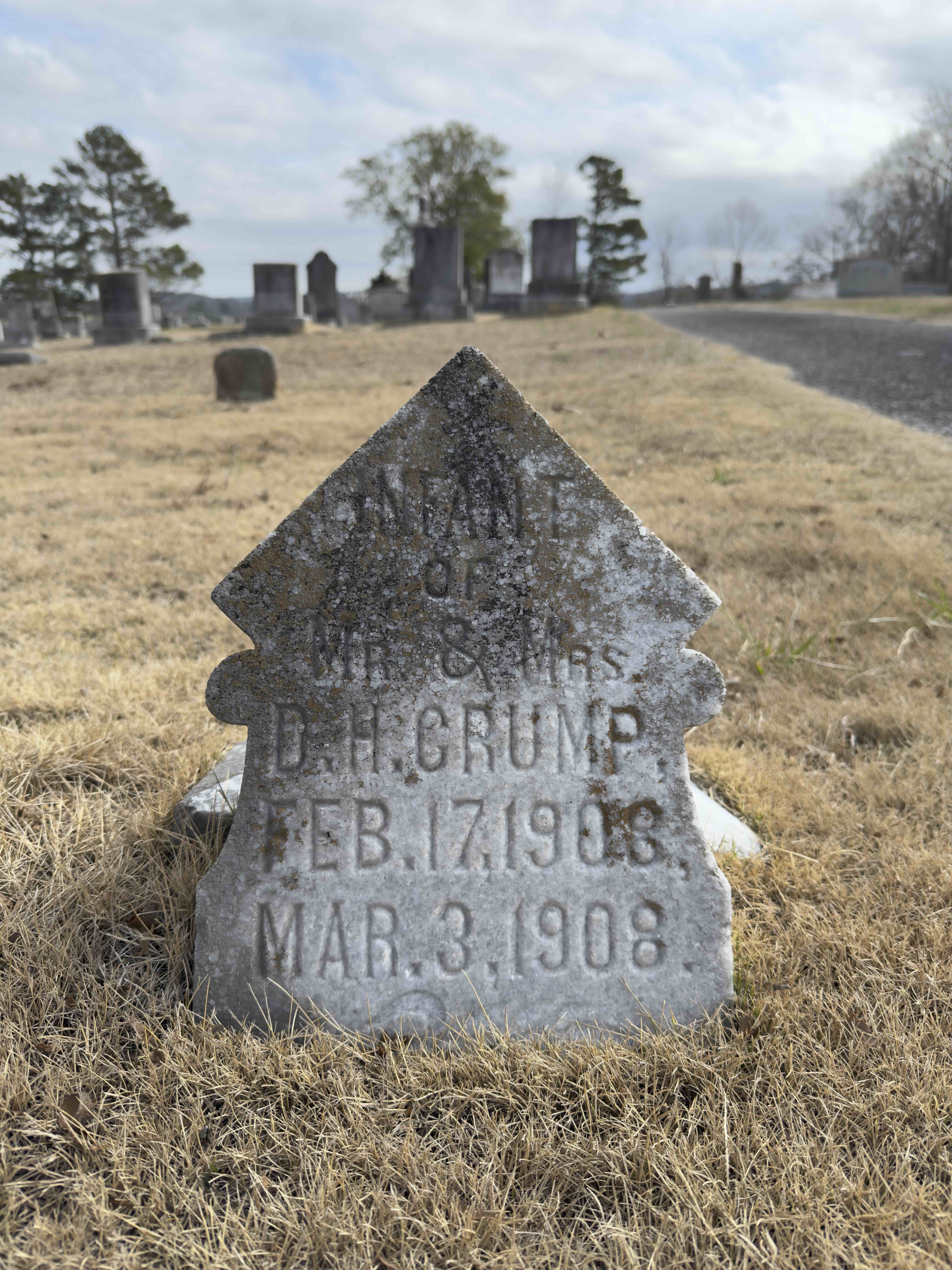
On March 3, Alabama Governor B.B. Comer was visiting Altoona.[40] Entertainment included a brass band and a parade for the governor. After the events, David Hanby returned home to find his wife dressed with a chair cushion tied over her head and declaring that she was ready to go to the opera. The Crump infant was soon discovered to be deceased, with burns from carbonic acid over its face and neck. At the time, Era Crump stated that she thought she was dressing the baby for the opera and mistook the acid for perfume. The infant was buried in the Crump plot of Altoona-Walnut Grove Cemetery, marked with a simple headstone.
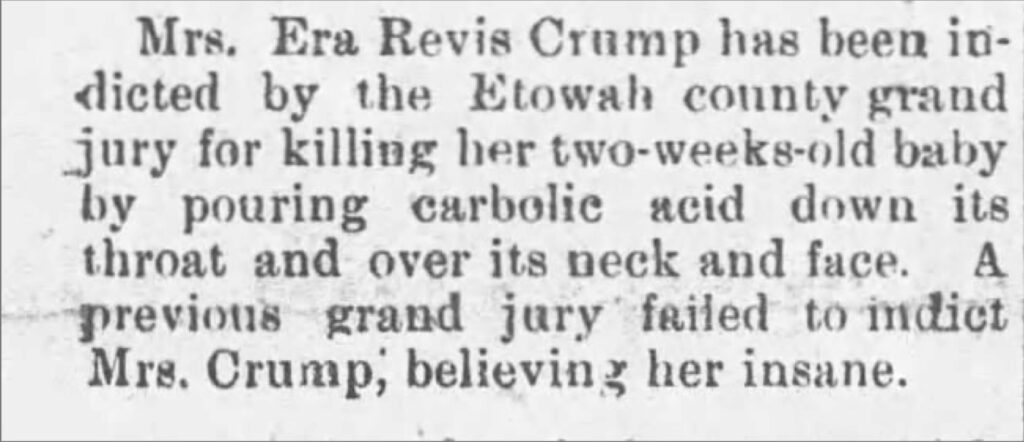
After Era’s original statement, the case was turned over to a grand jury, which failed to indict her, based on a case of insanity.[41] However, a second grand jury convened in June and sought to indict her for first-degree murder. On June 19, Deputy Sheriff John Lister came to Altoona and arrested Era Crump. [42] In early-November the case was tried before the Gadsden City Court, presided over by Judge Alto V. Lee. Reports from the time indicate the case was an “extraordinary one in several particulars and attracted much attention, although the public was excluded from the hearing.”[43]
Crump was represented by Goodhue & Blackwood, who argued that after the birth, Era began suffering from the effects of septic shock, which was not discovered until after the child’s death. This septic shock caused temporary insanity, which resulted in her appearance and the infant’s death on March 3. The defense also presented numerous legal and medical experts on the subject of “puerperal insanity.”
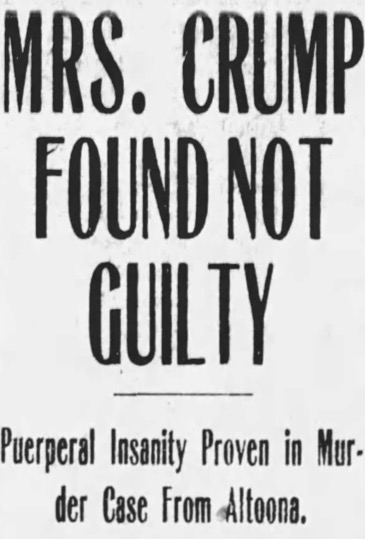
While the details of the prosecution’s case was not recorded, articles reported that the “state failed to make out its case.”[44] On the morning of November 6, just prior to jury deliberations, Judge Lee instructed the jury that if they returned a guilty verdict, he would set it aside because he felt that the evidence proved conclusively that Mrs. Crump was suffering from insanity.[45] Within an hour, the jury returned its verdict: not guilty by reason of insanity. Era Crump and numerous relatives left the courtroom smiling.
The Crumps’ life after the case remains largely unknown. The couple welcomed two additional children: sons David Hanby Crump Jr. (1909-1984) and Benjamin Reavis Crump (1911-1995). Crump remained active in the Pythias, serving as Secretary in 1909 and Master of Exchequer in 1910.[46] He also continued his tradition of serving as an election officer during the Altoona municipal election of 1910.[47] The 1910 U.S. Census records Crump and his family living at their 7th Avenue residence.[48] Surprisingly, Crump is not listed as a grocer or dry goods merchant. Instead, his occupation is that of a weighman at a coal mine. While he was unemployed at the time (along with other listed as a miners, possibly indicating a strike or layoffs), this census reveals the beginning of a transition for the Crump family.

On August 8, 1909, Crump sold his home and residential property to mother-in-law Mary Reavis.[49] In December, the site of his grocery business was sold to Miller Bain.[50] In December 1911, Crump recorded a $115 mortgage with the National Cash Register Company for a new cash register.[51] In January 1912, the Gadsden Times announced that Crump had opened a grocery store in on January 1, 1912, with an entire new stock.[52] The business was located at the Banks building on 5th Avenue in downtown Attalla. Since there are no deed records attributed to Crump during this period, it is assumed that he rented a residence in the city.

After a period in Attalla, Crump and his family relocated to Bessemer where he continued his business.[53] On August 12, 1918, after suffering from an illness, Crump’s wife Era, passed away. The funeral was held the following day at her childhood home in Walnut Grove. She was interred in Altoona-Walnut Grove Cemetery close to her infant daughter. A couple of weeks later, D.H. and his sons took out an ad in the Birmingham-Post Herald thanking their many friends for their kindness and flowers during their time of mourning their wife and mother.[54]
On the evening of May 3, 1922, Crump remarried a Miss Jessie Howell at the Methodist Church in Jonesboro, Alabama.[55] Howell was 40 years old, and her past is unknown. The wedding announcement reveals that Crump was no longer in the mercantile business, working with the Raymond Mining Company instead. [56] Crump’s activities from his marriage to the end of his life are unknown.
David Hanby Crump died on January 8, 1929, at Bryce Hospital in Tuscaloosa.[57] He was 55 years old and employed as a bookkeeper. Whether he was employed or a patient at Bryce at the time of death is not known. The Alabama death and burial index reveals that he was divorced from Jessie. It also reveals that Crump was residing in Tuscumbia, Alabama, and was buried in W.T. Gilbert Cemetery in Tuscumbia. A search for information on a W.T. Gilbert Cemetery in Tuscumbia reveals no results, and Crump’s listed residence and place of burial may be a transcription error. Since his place of death was at Bryce Hospital, it’s probable that his residence was in Tuscaloosa, regardless of whether he was working for or was a patient at Bryce. “W.T. Gilbert” could easily be a transcription error of Walnut Grove or W. Grove Cemetery. Despite the confusion, Crump is buried in Altoona-Walnut Grove Cemetery, between the grave of his wife and infant daughter.
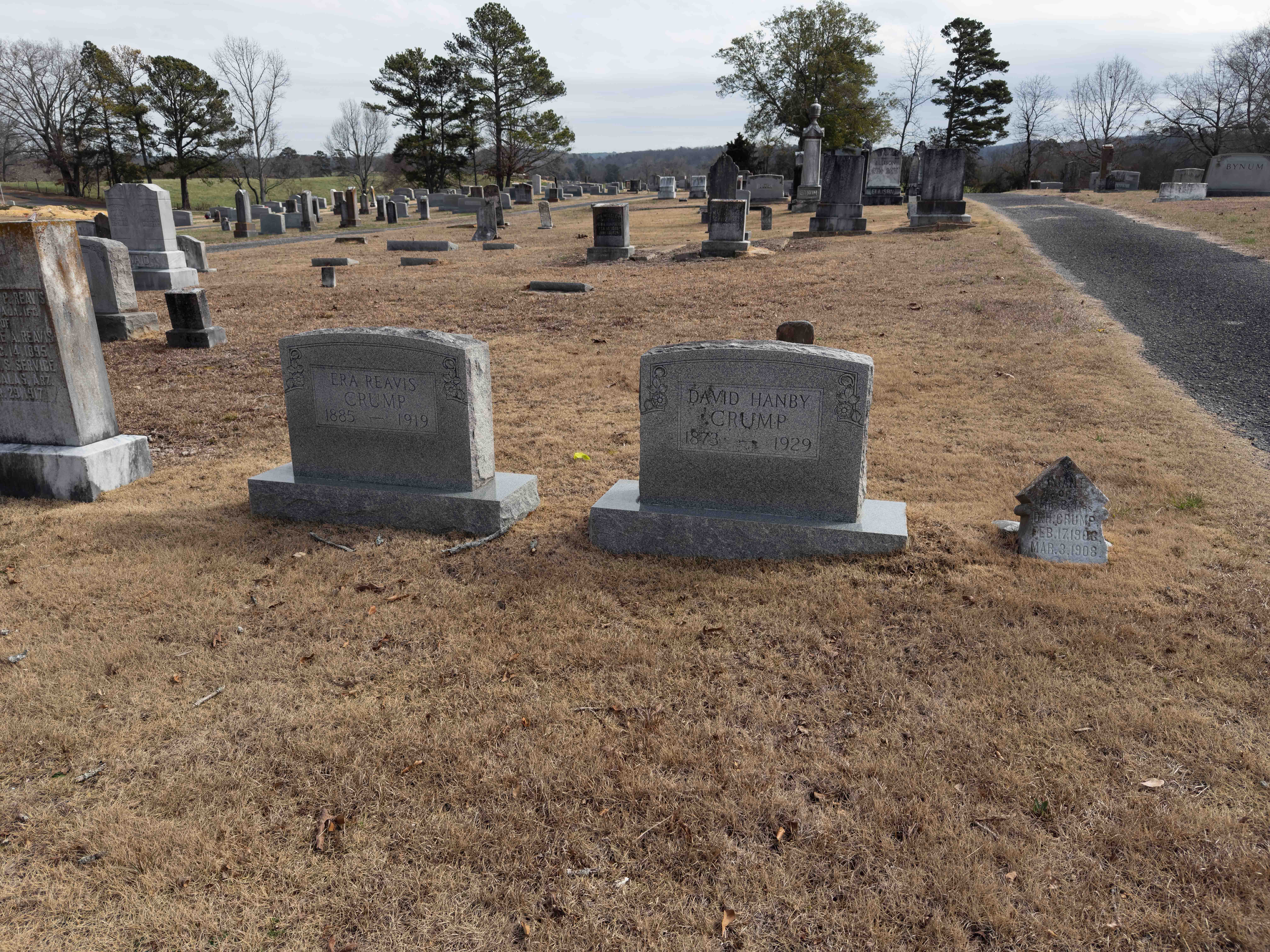
Reared in Blount County and descending from pioneering families, Crump was among the men who witnessed the genesis of Altoona. From serving in the Underwood Coal Company to working as a postmaster, store owner, and election manager, he saw Altoona grow from a small mining venture to a thriving town. Despite setbacks and tragedy, he continued his path of business ownership, even after leaving Altoona. In 2024, when searching for the name of the road going to the Altoona Water Tank, it was found that a 1905 plat of the Ellison Subdivision named the route Crump Street.[58] Nestled between Stanfield, Hale, Reavis, and Ellison Street, the plat reveals that Crump’s name was held in high regard among the other individuals who helped build Altoona into a town.
[1] Ancestry.com, billiejune8842 family Tree, https://www.ancestry.com/family-tree/person/tree/9935844/person/25127292991/facts
[2] Find a Grave, database and images (https://www.findagrave.com/memorial/33105753/john_pinckney-crump: accessed February 21, 2025), memorial page for John Pinckney Crump (20 Dec 1840–7 Feb 1895), Find a Grave Memorial ID 33105753.
[3] 1 February 1917, Southern Democrat, P1.
[4] Year: 1880; Census Place: Blount, Alabama; Roll: 2; Family History Film: 1254002; Page: 421D; Enumeration District: 005
[5] 1892 October 13, Southern Democrat, P3.
[6] 1893 December 28, Southern Democrat, P3.
[7] 1895 February 21, Blount County News Dispatch, P3.
[8] 5 May 1898, Liberty Church Cemetery Committee, Southern Democrat, P3.
[9] 19 May 1898, Southern Democrat, P3.
[10] “City Tax Sale,” 2 June 1898, Blount County News-Dispatch, P2.
[11] 10 August 1899, Blount County News-Dispatch, P3.
[12] Year: 1900; Census Place: Oneonta, Blount, Alabama; Roll: 3; Page: 14A; Enumeration District: 8; FHL microfilm: 1240003.
[13] 28 February 1901, Southern Democrat, P3.
[14] 24 October 1901, Blount County News Dispatch, P3.
[15] “Picnic at Altoona, ALA.,” 3 July 1902, Southern Democrat, P3.
[16] Postmasters by City,” Postmasters by City – Postmaster Finder – Who we are – About.usps.com, https://about.usps.com/who/profile/history/postmaster-finder/postmasters-by-city.htm.
[17] Letter from D.H. Crump to W.T. Underwood, December 24, 1902. Oscar Wilder Underwood Papers, LPR 29, Container 2, Folder 7. Alabama Department of Archives and History.
[18] Letter from W.T. Underwood to Oscar Underwood, December 27, 1902. Oscar Wilder Underwood Papers, LPR 29, Container 2, Folder 7. Alabama Department of Archives and History.
[19] Letter from W.T. Underwood to Oscar Underwood, February 27, 1904. Oscar Wilder Underwood Papers, LPR 29, Container 4, Folder 4. Alabama Department of Archives and History.
[20] Letter from W.T. Underwood to Oscar Underwood, March 2, 1904. Oscar Wilder Underwood Papers, LPR 29, Container 4, Folder 5. Alabama Department of Archives and History.
[21] Letter from W.T. Underwood to Oscar Underwood, March 12, 1904. Oscar Wilder Underwood Papers, LPR 29, Container 4, Folder 5. Alabama Department of Archives and History.
[22] “Altoona: Postmasters by City.” Postmasters by City – Postmaster Finder – Who we are – About.usps.com. https://about.usps.com/who/profile/history/postmaster-finder/postmasters-by-city.htm.
[23] Kincaid A. Herr, The Louisville & Nashville Railroad, 1850-1942 (Louisville, Ky: L. & N. Magazine, 1943), P79.
[24] Etowah County Marriage Book K, Page 114.
[25] “Turner Family Tree,” ancestry user KATHRYN DECRANE, https://www.ancestry.com/family-tree/person/tree/166301926/person/142187391219/facts
[26] Jesse French Piano and Organ to D.H. Crump 10/27/1902, Etowah County Deed Book, C-C-522
[27] “NOTICE,” 26 May 1904, Southern Democrat, P3.
[28] “Friends,” 2 June 1904, Southern Democrat, P5.
[29] D.H. Crump from W.J. Ellison 11/1/1904, Etowah County Deed Book L-L-371
[30] “Altoona News Items Town to Incorporate,” 6 October 1905, Gadsden Tines, P1.
[31] “Altoona citizens to give to Virginia Mine sufferers,” 14 October 1905, Birmingham News, P18.
[32] Members Of Altoona Lodge No. 612 (Formerly W.T. Underwood Lodge No. 612 [1904-1908], document in possession of author. 9 March 1906, Birmingham News, P7.
[33] D.H. Crump to R.B. Lacy (Mortgage) 5/4/1906, Etowah County Mortgage Book M-67-220
[34] “West Point,” 2 May 1907, Birmingham News, Page 10.
[35] “R.3. Altoona,” Southern Democrat, 3 October 1907, P1.
[36] “Altoona Elects Council February 10,” 6 January 1908, Gadsden Times, P1.
[37] 2 May 1908, Gadsden Times, P4.
[38] “R.3. Altoona,” 5 March 1908, Southern Democrat, P5.
[39] Most contemporary family trees list the child as a daughter. This may be based on the 1910 census that reveals Era birthed two male and a female. However, news articles from the time do not reveal a gender or name.
[40] “Mrs. Crump found not guilty,” 6 November 1908, Gadsden Times P1.
[41] 1 July 1908, The Choctaw Advocate, Butler, Alabama, P1.
[42] “News of Altoona,” 23 June 1908, Birmingham News, P10.
[43] Ibid. #39.
[44] Ibid. #39.
[45] “She was innocent,” 19 November 1908, Southern Democrat, P3.
[46] “The Pythias Had Big Time,” 19 August 1909, Gadsden Times, P1. “Officers Installed,” 4 January 1910, Birmingham Post-Herald, P3.
[47] 11 April 1910, Gadsden Times, P1.
[48] Year: 1910; Census Place: Altoona, Etowah, Alabama; Roll: T624_13; Page: 3B; Enumeration District: 0079; FHL microfilm: 1374026
[49] D.H. Crump to M.V. Reavis 8/8/1910 Etowah County Deed Book UU-306
[50] D.H. Crump to Miller Bain 12/10/1910 Etowah County Deed BooK YY-126
[51] D.H. Crump to National Cash Register Etowah County Mortgage Book M82-75
[52] 2 January 1912, Gadsden Times, P2.
[53] 1 July 1919, Gadsden Times, P4.
[54] “Card of Thanks,” 25 August 1918, Birmingham Post-Herald, P21.
[55] Jefferson County Marriage Record Volume 3, Page 52.
[56] 12 May 1922, Gadsden Times, P7.
[57] Ancestry.com. Alabama, U.S., Deaths and Burials Index, 1881-1974 [database on-line]. Provo, UT, USA: Ancestry.com Operations, Inc., 2011.
[58] Etowah County Subdivision Plat B9. Ellison Subdivision, November 28, 1905. Plat is incorrectly transcribed with the nae Crimp Street.

Be First to Comment