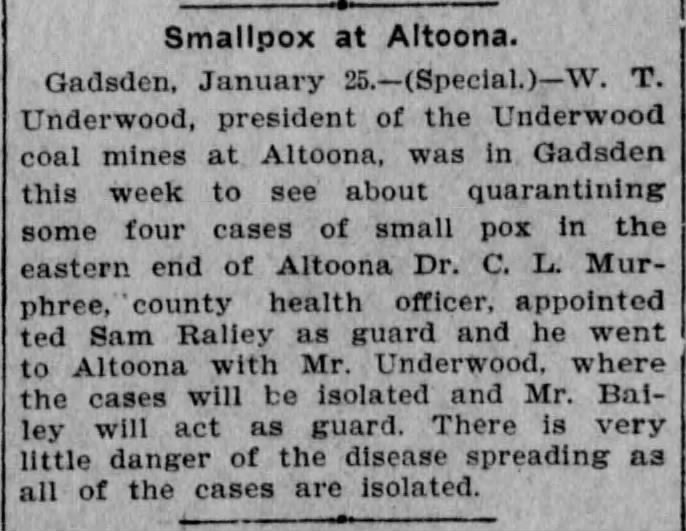
Throughout human history, one of the most feared viruses was smallpox. Although eradicated today, at one time the virus did not discriminate its victims: ancient Egyptians, kings, and presidents were all effected by the disease. Growing up, I had always through of smallpox as a deadlier version of chickenpox. Later, my understanding of it came from the HBO miniseries John Adams. That series includes a scene where the Adams family were inoculated against the disease. The inoculation, combined with other advances in medicine resulted in the decline of smallpox by the 20th century. However, outbreaks would still occur, with the first cases coming to Altoona in 1904. In January, the Birmingham Post-Herald reported.[1] “W.T. Underwood, president of the Underwood coal mines at Altoona was in Gadsden this week to see about quarantining some four cases of smallpox in the eastern end of Altoona. Dr. C.L. Murphree, county health officer, appointed Sam Raliey as guard and he went to Altoona with Mr. Underwood, where the cases will be isolated and Mr. Bailey will act as guard. There is very little danger of the disease spreading as all of the cases are isolated.”
Smallpox in Altoona first came to my attention while searching through old Altoona town council minutes for another project. I came across an interesting entry from January 3, 1918.[2] “Mr. L.T. Taylor offered the use of his vaccine machine free of charge to the town of Altoona which was accepted with thanks.”[3] Unfortunately, without any other context, I was left wondering what called for the use of a vaccine machine? My first thought was rabies vaccines for dogs. However, there was no earlier mention of rabies, dog tags, or nuisance issues related to canines. I later thought about the year, and my mind jumped to the Spanish flu. Upon research, the first Spanish Flu case in Alabama was reported in September 1918, 9-months after the entry in the council minutes.[4]
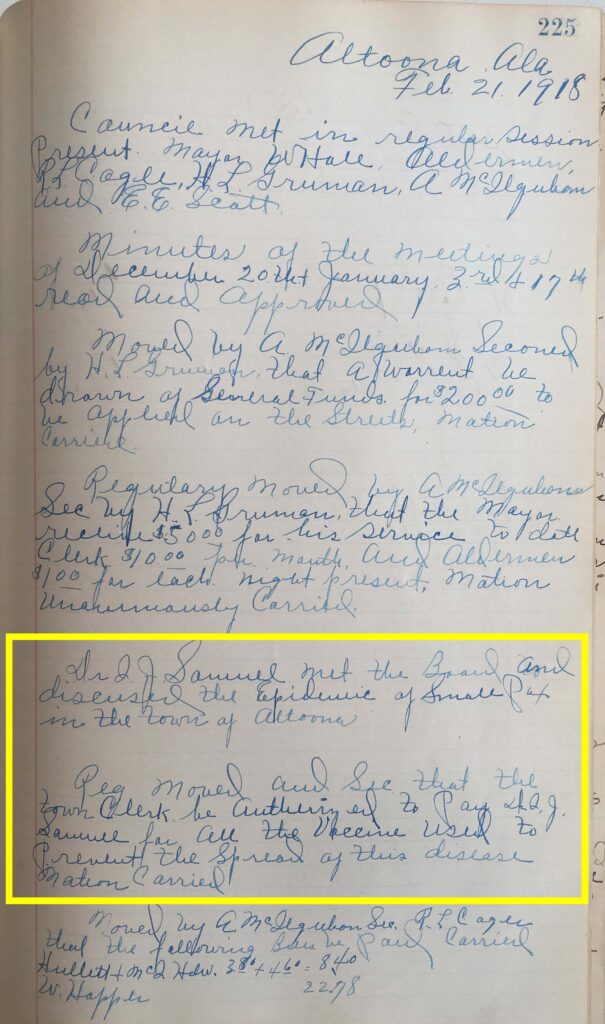
The answer to the question came in the form of the next meetings minutes on February 21, 1918, “Dr. I.J. Samuel met the board and discussed the epidemic of Smallpox in the town of Altoona. ”[5] This was followed by the next entry, “Motion made that the town clerk be authorized to pay I.J. Samuel for all the vaccines used to prevent the spread of this disease motion carried.”The vaccine machine was not for rabies or Spanish flu, but the Smallpox epidemic that had overtaken the town.
Altoona was not alone in the outbreak of Smallpox. In mid-December 1917, 25 cases were reported in Calhoun County.[6] To get ahead of the disease, public health officials vaccinated over 4000 individuals.[7] In late December 1917, a case was reported in Tuscaloosa, causing apprehension in the city.[8] Talladega County also reported a number of cases and excused all unvaccinated children from attending school.[9] The largest outbreak occurred in January-February 1918 in Jefferson County. County Health Officer, Dr. J.D. Dowling attempted to get ahead of the outbreak by urging citizens to get vaccinated by noting the alarming number of cases reported in nearby counties.[10] Despite the plea, by mid-February around 70 individuals were confined at the county, “pest-house”.[11] By the end of March, the Birmingham outbreak was considered to be over, and reports out of Anniston ceased altogether.[12]
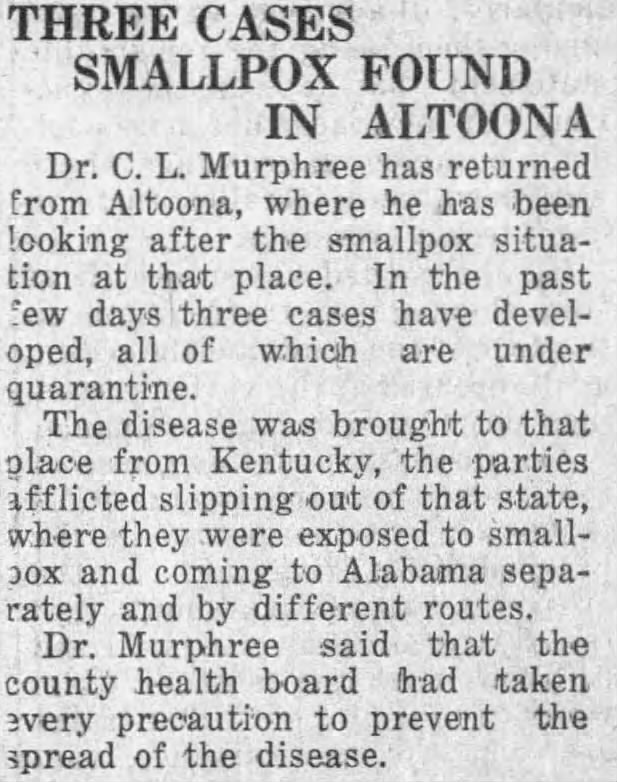
Unfortunately, it’s not recorded how many cases of smallpox were reported in Altoona, or how many individuals were vaccinated. The three recorded statements in the council minutes are the only sources that remain documenting an epidemic in Altoona. Despite the motion, no record of paying Dr. Samuel for the vaccines has been found. Interestingly, three years later another small outbreak in the town was reported. An article in the Gadsden Times reads,[13] “Dr. C.L. Murphree has returned from Altoona where he has been looking after the smallpox at that place. In the past few as three cases have been developed, all of which are under quarantine. The disease was brought to that place from Kentucky, the parties afflicted slipping out of that state, where they were exposed to smallpox and coming to Alabama separately and by different routes. Dr. Murphree said that the county health board had taken every precaution to prevent the spread of the disease.”
The 1920 outbreak was the last recorded case of the virus in Altoona. By 1938, only 48 cases of smallpox were reported in the entire state of Alabama, and only five deaths had been reported over the past 10 years.[14] By 1951, Alabama reported zero cases of smallpox.[15] In 1980, the World Health Assembly declared that smallpox had been eradicated worldwide, marking an end to the once feared virus.
[1] “Smallpox at Altoona,” 26 January 1904, Birmingham Post-Herald, P.8.
[2] Altoona Town Council Minute Book 1910-1924.
[3] Taylor was a town councilman.
[4] https://wbhm.org/2020/surviving-pandemic-1918-spanish-flu-changed-life-alabama/#:~:text=The%201918%20flu%20was%20especially,25%2C000%20cases%20in%20the%20state.
[5] Altoona town Council Minute Book 1910-1924.
[6] “Smallpox cases reported in Anniston,” 16 December 1917, The Anniston Star, P.8.
[7] “Aggressive War Made on Disease,” 11 January 1918, The Birmingham News, P.5.
[8] “Smallpox is reported,” 27 December 1917, The Southern Democrat, P.2.
[9] “School children must be vaccinated,” 2 January 1918, Our Mountain Home, Talladega, Alabama, P.3.
[10] “Vaccination is urged in county,” 2 January 1918, The Birmingham News, P.2.
[11] “Drastic steps to check smallpox epidemic taken,” 10 February 1918, The Birmingham News, P.1.
[12] “No patients reported,” 20 March 1918, The Birmingham News, P.11.
[13] “Three cases smallpox found in Altoona,” 19 March 1920, The Gadsden Times, P.1.
[14] “Only five smallpox cases result in death in 10 years,” 17 March 1938, The Southern Democrat, P.7.
[15] “No smallpox in state,” 19 July 1951, The Southern Democrat, P.2.

Be First to Comment