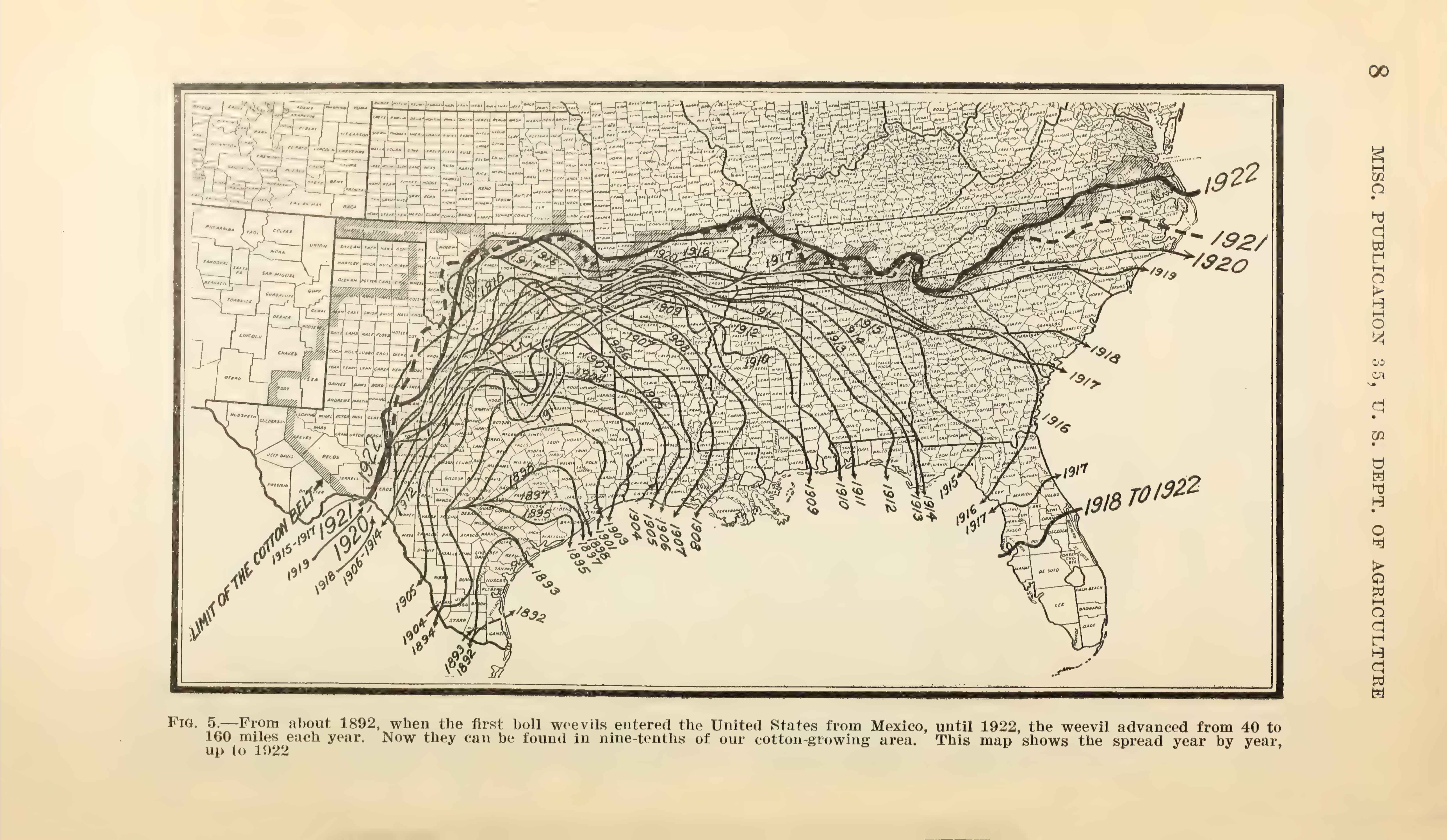
The boll weevil is an invasive pest that had devastated many cotton fields and led to the collapse of many farms. Originally found in Mexico, the pest entered the United States via Texas in 1892. The weevil entered Alabama in 1910 and continued its march through the state season after season.[1] However, the Weevil did not reach Altoona until 1916, when it became the first appearance of the pest in Etowah County.
Farmers in the area knew that the boll weevil would eventually come to the county, with a delegation of East Alabama farmers traveling to Mississippi to study the pest as early as 1914.[2] At that time, it was reported that the farmers would about a year or two to prepare for the invasion of the weevil in East Alabama. The appearance in Etowah County happened exactly two years as reported by the Birmingham News,[3] “A family of big black boll weevils, the first genuine members of the tribe in the county this year, were received by county Agent Gissendamer this morning from W.J. Ellison, of Altoona, and are now on exhibition at the Chamber of Commerce. Mr. Ellison said the boll weevils are abundant within a mile or two of Altoona. The weevils which arrive this Fall will hibernate and begin activities next Spring.”
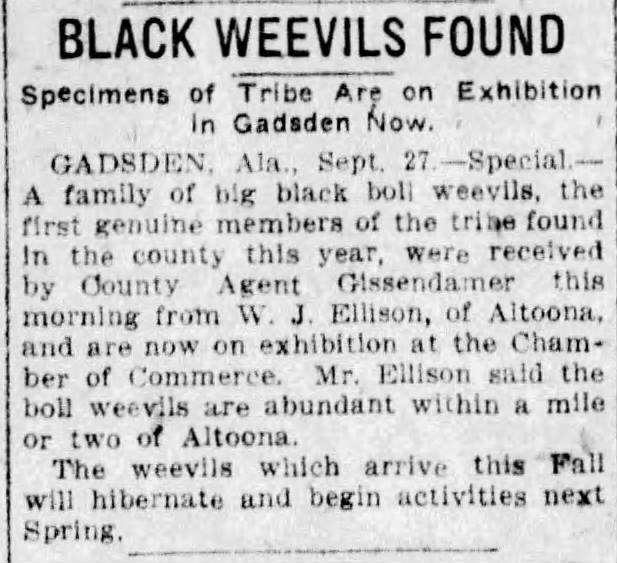
The Birmingham Post-Herald added more context,[4] “A few weevils were found in the county last year, but they arrived at such a stag that all died out during the winter.” A search for a report on the weevils from 1915, found no mention of a previous appearance in the county. The Herald article later states, “There have been numerous reports of the boll weevils in the county this year, but in each age were examined by experts they have been found to be some other member of the weevil family.”
Like the other reports of boll weevils, the Altoona weevils were sent for examination by experts. The Results were reported in the the Gadsden Times,[5] “Some of the boll weevils recently found near Altoona were sent to W.E. Hinds, sate entomologist, by Carl Lay, of this city (Gadsden), and Mr. Hinds has pronounced them the genuine Mexican cotton boll weevils. ‘The fact that you have found them on so many farms indicated that they are generally distributed and in considerable abundance throughout that section,’ Mr. Hinds stated in his letter.”
In response to the appearance of the weevil, many farmers prepared to reduce their cotton acreage in 1917.[6] In his letter, Hinds added that no one could tell the damage that the weevil would cause the following year. “The earliness of the killing frost and the character of the winter. I think you may look to 20 to 25 per cent loss in 1917.”[7]
The exact loss by Altoona or Etowah County farmers the following year could not be found. However, the weevil continued it march through the area. An opinion in the Boaz Leader wrote,[8] “Sand Mountain farmers will do well to remember that the boll weevil will very likely be here this year in considerable numbers and the only successful way found so far to fight this pest is by raising for man and a beast a living at home.” Blount County was also unaffected by the weevil in 1918 with a Mrs. Newcomer of Wynnville writing,[9] “The boll weevil did not arrive in time to do much damage here but are here ready to get an early start next year.”
By 1918, the boll weevil was present in every county in Alabama. Economic losses to the weevil in Alabama were $20 to $40 million each year for more than 80 years. Some historians consider the boll weevil the most important event in Alabama history until the mid-twentieth century, eclipsed only by the Civil War. In 1950, the battle against the weevil made a turn in the positive with the introduction of pesticides. Then in 1987, Alabama introduced an eradication program which was successful in removing the pest from the state by 2003.
[1] https://encyclopediaofalabama.org/article/boll-weevil-in-alabama/
[2] “Lafayette citizens leave Selma today,” 22 August 1914, The Montgomery Advertiser, P.2.
[3] “Black weevils found,” 27 September 1916, The Birmingham News, P.(.
[4] 28 September 1916, The Birmingham Post-Herald, P.2.
[5] “Genuine weevil in this county says Hinds,” 10 October 1916, Gadsden Times, P.1.
[6] Ibid., #4
[7] Ibid. #5
[8] 5 April 1917, The Boaz Leader, P.2.
[9] “Mrs. Newcomer’s Letter” 8 November 1917, The Southern Democrat, P.8.

Be First to Comment